Visit Toad Hall’s Facebook page — you’ll find a 10% OFF coupon there that you can use between now & Christmas.
Moles Holes, and Voles ~ First published December 2008
“Bother!” Overnight, beneath the low-lying boughs of holly, there appeared a pint-sized mountain of freshly dug earth, surrounded by several tunnel entrance and exit holes.
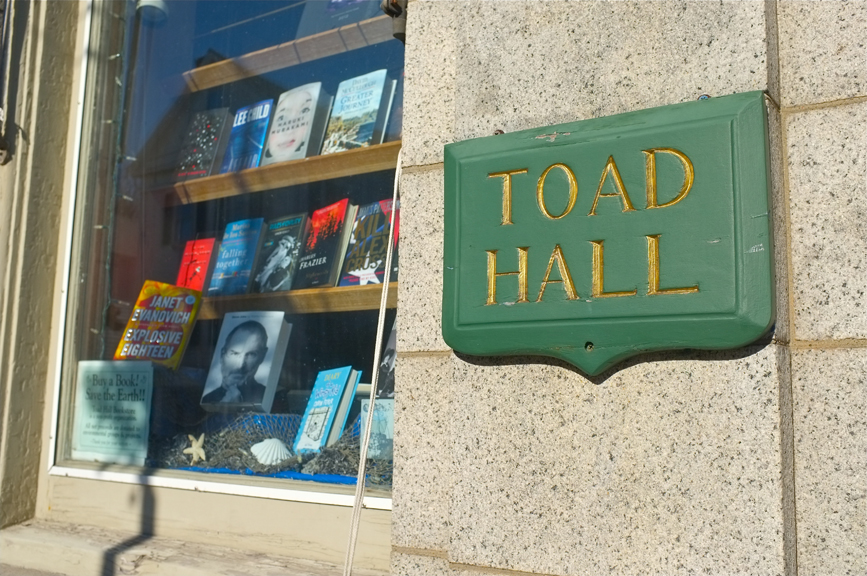
 Toad Hall Bookstore is a nonprofit organization and gives 100% of its net profits to environmental projects.
A day goes by and a second messy mound appears. “Such a rumpus everywhere!” Is it Mole or Ratty who has come built his winter residence on our lot? “Oh my! Oh my! Oh my!” I do hope it is Mole and not Rat. Investigating burrowing critters, moles and voles in particular, I was immediately transported back to the Wild Wood of Wind in the Willows. Perhaps you may recall Kenneth Grahame’s adventures of the anthropomorphized small creatures—good-natured Mole, Ratty (a water vole), Toad (well-to-do, jovial, and full of conceit), and lone Badger—and Grahame’s imaginative descriptions of their dwellings (Toady’s Toad Hall) that lie beneath the earth of field and wood and riverbank.
After reading about each and every suspect burrowing creature listed on the Massachusetts Wildlife’s State Mammal List, I believe that our new neighbor, fortunately for us, is a mole, not a vole. Voles are unwelcome garden guests; they delight in carbohydrate-rich spring flowering bulbs, roots and tubers of hosta and hollyhocks, and many other perennials. Voles cause serious damage; however, the deep tunneling habit of both moles and voles plays an important role in the overall health and vigor of soil, aerating and pulling topsoil down and subsoil upwards. In the garden, the cat that is allowed outside at night is the best defense against voles (really not recommended, for the cat that is, in communities where dwell coyotes). In areas where damage to food crops has been extensive, farmers have had the greatest success with installing raptor poles to encourage birds of prey.
Aside from examining the holes and surrounding mess, which we found did not give a clear identification, we discovered an easier way to determine whether mole or vole. Quarter an apple and skewer with a stick. Lay the skewered apple slice across the hole that appears to be the primary entrance. Our Scottish terrier conveniently and enthusiastically led the way. Within twenty-four hours you should see identifying signs of chewing. In our little experiment, it took less than four hours. Members of the Order Rodentia will leave large parallel teeth marks in the soft flesh of the apple whereas moles, which do not have large teeth, leave behind telltale shredding. Not only was the apple slice shredded, the mole had flung the remains, stick and all, a foot away from his tunnel entrance.
Of the three species of moles found in New England, we can narrow it down to two, either Scalopus aquaticus, the Eastern Mole, or Parascalops breweri, the Hairy-tailed Mole. We ruled out Star-nosed Mole. Both Eastern Moles and Hairy-tailed Moles construct two different types of tunnels. Built just beneath the surface of the earth are temporary, or feeding, tunnels and they are created by the mole during its search for earthworms, beetles, and grubs. The deeper tunnels constitute the moles living quarters, winter retreat, and nesting site. Star-nosed Moles construct only the feeding tunnels. All three New England species, like many species of moles, are called fossorial—adapted to digging—and have fossorial feet. The moles short paddle-like front feet are disproportionately large, as broad as they are long.
The dense, silky fur of moles lies equally well when brushed forward or backward, allowing ease of movement in either direction in its subterranean burrow. Their tiny eyes are covered by fused eyelids concealed in fur. Eastern Moles have gray-brown fur and the face, feet, and tail are pinkish-white, with a sparsely-haired tail. The Hairy-tailed Mole is more robust withshiny jet fur and a densely-haired tail. Both hairy-tailed and eastern moles do not hibernate; they are active all year round, day and night. Except during the breeding season, they live solitary lives. Few animals prey on moles because of their musky odor and burrowing habit. Snakes, owls, and foxes are their main predators.
I could hardly bring myself to think about how to rid our garden of a creature such as one who resides in the pages of this beloved childhood book. Why don’t we wait and see, leave it be, I pleaded with my husband. The grub-eater is a gardener’s friend.
Recently I stopped by Toad Hall Bookstore. Warm and welcoming, a thoroughly relaxing ambiance, and chock-a-block full of enticing, beautiful and thoughtful gifts. Don’t you find the most memorable gifts from childhood are the storybooks given from loving adults—parents, grandparents, or that special aunt? Perhaps a copy of The Wind in the Willows, originally published in 1908, would make a treasured gift for the young reader on your list. We found a pristine second-hand copy illustrated with line drawings by Ernest H. Shepard. This 1960 Charles Scribner’s Sons edition had eight additional color illustrations, also rendered by Shepard, commissioned to celebrate the books mid-century birthday. Currently available is a hardcover centennial anniversary edition, published by Atheneum Books for Young Readers.

 I was standing so still while filming yesterday morning that I don’t think the female mallard was at first aware of my presence. What a wonderful treat to see she and the ducklings emerge from the reeds growing along the water’s edge. They are amazingly fast and adeptly darted through the water and across the beach, as though they had been born months earlier. I was getting a tremendous cramp and had to stand quickly, which was mama mallard’s cue to chide the ducklings back into the tall grass.