Category Archives: Creating a Butterfly Garden

How Exactly is Monsanto’s Roundup Ravaging the Monarch Butterfly Population?

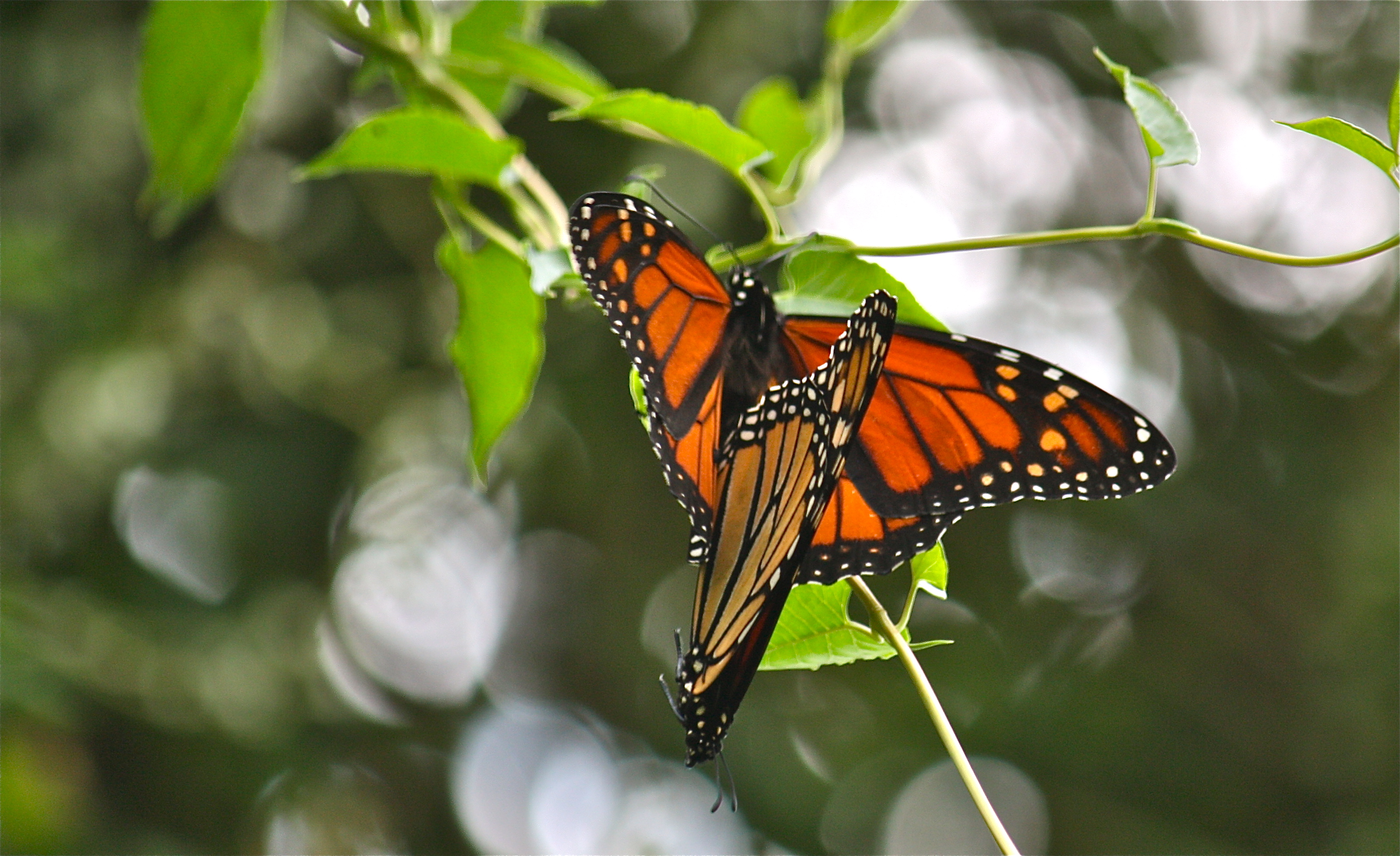
Monarch Butterfiles Female left Male right Milkweed ©Kim Smith 2012

The above photo of a male (right) and female (left) Monarch Butterflies on Marsh Milkweed is part of the GMG/Cape Ann Giclee Photography show, opening tonight, Friday. Hope to see you there!

I am often asked the following question at my butterfly  and pollinator garden design lectures. How exactly are Monsanto’s products ravaging the Monarch Butterfly population?

First, it is important to understand that all butterfly caterpillars rely on plant foods specific to each species of butterfly. For example, Monarch caterpillars only eat members of the milkweed family, Black Swallowtail caterpillars eat plants in the carrot family, and Heliconian butterflies eat plants in the passionflower family. Some caterpillars, like the larvae of the Eastern Tiger Swallowtail eat plants from a wide range of plant families. That being said, it is worth repeating that Monarch caterpillars only survive on members of the milkweed family.

Imagine a farm with row upon row of corn. Growing amongst and around the edges of the cornfields are wildflowers of all sorts, including milkweed. The wildflowers draw to the fields myriad pollinators such as bees, butterflies, and birds.

Monsanto has genetically modified the seed of corn and soybeans so that it will withstand extremely heavy doses of its herbicide, called Roundup. Monsanto’s corn and soybean seed is actually called Roundup Ready. Roundup Ready plants can withstand massive doses of the herbicide Roundup, but the milkweed and other wildflowers growing in the corn and soybean fields cannot.

Each year massive amounts of Roundup are sprayed on the corn and soybean fields, killing everything in sight, except the Roundup Ready corn and soybean. Additionally, Monsanto’s Roundup contains the active ingredient glyphosate, which has been tied to more health and environmental problems than you can possibly imagine.

Now imagine you are a Monarch Butterfly, having flown hundreds of miles northward towards breeding grounds of milkweed. But there is no milkweed to deposit your eggs. The circle in the chain of life is broken.

Since the use of genetically modified Roundup Ready began, milkweed has disappeared from over 100 million acres of row crops, or a roughly 58 percent decrease. Milkweed is not only the Monarch caterpillar host (or food) plant, the nectar-rich florets provide nourishment for hundreds of species of bees and other Lepidoptera.

The Monarch Butterfly migration is one of the great migrations of the world. Climate change and the loss of habitat are also factors in the decrease of butterflies. The Mexican government and the people of Mexico have enacted policies to help protect from logging the remaining oyamel fur trees in the Monarchs winter habitat.

There are several steps that we in the United States can undertake. 1) Avoid as much as possible genetically modified food, especially corn and soybean products. 2) If you own shares of Monsanto stock, get rid of it (Monsanto also developed Agent Orange). Thirdly, we need to start a national movement to cultivate milkweed and to create awareness about the important role wildflowers play in our ecosystem.

Calling Everyone: Plant Milkweed! No matter how small or large your garden, give a spot over to milkweed and watch your garden come to life!

http://onlinelibrary.wiley.com/doi/10.1111/j.1752-4598.2011.00142.x/full

Lecture Tonight ~ The Pollinator Garden

Tired of the monochromatic New England landscape? Tonight, Thursday, I am giving my lecture program The Pollinator Garden from 7 to 9 at the Andover Public Library Memorial Hall. The public is welcome.

Pink flowering dowood Cornus florida rubra

North American Native Pink-flowering Dogwood ~ Cornus florida rubra

Willowdale Estate Wins TV Show TLC Four Weddings!!!

Four Brides Judge Each Other’s Weddings. Even with Superstorm Sandy threatening to dampen Enza and John Procopio’s special day, Willowdale takes the cake!

“In Italian tradition, rain is supposed to be good luck. We have the hurricane, so that means we are going to have life-long happiness.”  said groom John Procopio.

Willowdale Estate Topsfield ©Kim Smith 2012

Willowdale Estate pulled out all the stops to make the event a success. The competing brides loved the catering “My sea bass was fantastic!” said one competing bride. Willowdale received a perfect score for the catering and also achieved the highest score for guest experience. The couple walked away with a luxury vacation in the Caribbean Islands and a wedding story that will be in the family for many years.

http://tlc.howstuffworks.com/tv/four-weddings/and-the-winner-isenza.htm

Watch the full episode:

http://tlc.howstuffworks.com/tv/four-weddings/videos/and-a-super-storm.htm

Willowdale Estate is a special events venue in Topsfield Massachusetts that provides celebrated restaurant style catering for all events, as well as complementary planning services. Willowdale’s fieldstone mansion is surrounded by over 700 acres of forest, the Ipswich River, and beautiful flowering gardens (designed by me!), with sweeping views, privacy, and endless possibilities for any event. Willowdale Estate is a full service venue with many amenities including a pristine Sperry Tent, equipment, and guidance from our experienced event planners.  For more information about planning your wedding, corporate event, or fundraiser contact Info@WillowdaleEstate.com or call 978-887-8211

Garden Design Lecture Thursday Night in West Newbury

Think Spring!

Lilac and Red Admiral ©Kim Smith 2012

Lilac ‘Maiden’s Blush’ (Syringa vulgaris) and the Friendly Red Admiral

Tomorrow night I am presenting one of my garden design lectures in West Newbury. For a complete list of programs that I offer, see the Programs page on my blog. For a list of upcoming lectures and programs, see the Events page on my blog.

Note: Program Rescheduled for June 6th.

Magnolia sieboldii bud ©Kim Smith 2012Oyama Magnolia Bud (Magnolia sieboldii)

The Oyama Magnolia is often planted adjacent to tea gardens in Japan because the blossom of the small tree nods downward, allowing the seated person to look up into the face of the flower. The first time I  saw (or should say smelled) Magnolia sieboldii was in a wholesale nursery close to the Rhode Island border, where a single large specimen was tucked in with other more common species of magnolia. The divine fragrance emanating from the tree had drawn me towards it. The tree was unmarked, but since I so strongly value fragrance in plants, I had read about it and knew exactly what it was. Spring had not yet sprung in Gloucester and the honeysuckle sweet and citrus fragrance was intoxicating to my winter weary brain. I tied my tag around to claim it and have adored this tree since the day our Oyama Magnolia arrived to our garden.


Congratulations Emily Forshay Crowley-Winner of Oh Garden of Fresh Possibilities!

Dear Friends,

I truly wish I could give each and everyone of you who wrote your thoughtful and cherished comments a copy of Oh Garden. Thank you.

Warmest wishes for a joy-filled holiday season and many thanks again for your participation.

Kim

Oh Garden of Fresh Possibilities! .jpg

Oh Garden of Fresh Possibilities! On sale for 15.00 at David R. Godine, Publisher

Win a FREE Copy of Oh Garden of Fresh Possibilities!

Eastern Tiger Swallowtail©Kim Smith 2010

Tuesday through Friday of this week I will be bringing you expert gardening advice excerpted from my book Oh Garden of Fresh Possibilities! Notes from a Gloucester Garden. My book is currently on sale on my publisher’s website (David R. Godine) for the unheard of price of 15.00 (the list price is 35.00.) In response to Godine’s super sale, I am offering a free copy of my book.

Leave a comment or question on any of the posts by Friday at 8PM to be entered into the drawing to win. Multiple entries are allowed. One person will be chosen at random. The book will be shipped on Monday, the 17th, which should allow time for it to arrive by Christmas. Shipping is included to addresses within the United States and Canada.

Praise for Oh Garden: Smith’s writing is lithe and clean and her experiences in conjuring beauty out of her garden in Gloucester make for excellent reading.
—Hawk and Whippoorwill

Excerpt from Oh Garden of Fresh Possibilities! Part One: Creating the Framework, Chapte Three ~ Planting in Harmony with Nature

Magnolia virginiana ~ Sweetbay Magnolia

Located in the heart of Ravenswood Park in Gloucester there is a stand of Magnolia virginiana growing in the Great Magnolia Swamp. It is the only population of sweetbay magnolias known to grow this far north. I took one look at the native sweetbay magnolia and breathed in the fresh lemon-honeysuckle bouquet of the blossoms, fell in love, and immediately set out to learn all I could about this graceful and captivating tree.

Magnolia virginiana ©Kim Smith 2012 copy

Returning from a trip to visit my family in northern Florida, I had tucked the bud of a the Southern magnolia (Magnolia grandiflora) into my suitcase to paint upon my return. I was dreaming of someday having a garden large enough to accommodate a Magnolia grandiflora and was elated to discover how similar our sweetbay magnolia is to the Southern magnolia. For those not familiar with the Southern magnolia, it is a grand, imposing specimen in the landscape, growing up to fifty feet in the cooler zones five and six, and one hundred feet plus in the southern states. M. grandiflora is the only native magnolia that is evergreen in its northern range, flowering initially in the late spring and sporadically throughout the summer. The creamy white flowers, enormous and bowl-shaped (ten to twelve inches across), emit a delicious, heady sweet lemon fragrance.

In contrast, the flowers of the sweetbay magnolia are smaller, ivory white, water-lily cup shaped, and sweetly scented of citrus and honeysuckle. The leaves are similar in shape to the Magnolia grandiflora, ovate and glossy viridissimus green on the topside, though they are more delicate, and lack the leathery toughness of the Southern magnolia. The lustrous rich green above and the glaucous silvery green on the underside of the foliage creates a lovely ornamental bi-color effect as the leaves are caught in the seasonal breezes.

Magnolia virginiana is an ideal tree for a small garden in its northern range growing to roughly twenty feet compared to the more commanding height of a mature Southern magnolia. M. virginiana grows from Massachusetts to Florida in coastal freshwater wetland areas as an understory tree. The tree can be single- or multi-stemmed. Sweetbay is a stunning addition to the woodland garden with an open form, allowing a variety of part-shade loving flora to grow beneath the airy canopy. The leaves are a larval food for the Eastern Tiger Swallowtail butterfly. Almost immediately after planting we began to notice the swallowtails gliding from the sunny borders of the front dooryard, where an abundance of nectar-rich flowers are planted specifically to attract butterflies, around to the shady border in the rear yard where our sweetbay is located.

Garden designs are continually evolving. Part of our garden has given way to a limited version of a woodland garden, for the shady canopy created by the ever-growing ceiling of foliage of our neighboring trees has increasingly defined our landscape. We sited our Magnolia virginiana in the center of our diminutive shaded woodland garden where we can observe the tree from the kitchen window while standing at the kitchen sink. Gazing upon the tree bending and swaying gracefully in the wind, displaying its shifting bi-color leaves, provides a pleasant view when tending to daily chores.

See Tuesday’s excerpt about pear trees

Eastern Tiger Swallowtail ©Kim Smith 2010Eastern Tiger Swallowtail

Win a FREE Copy of Oh Garden of Fresh Possibilities!

Tuesday through Friday of this week I will be bringing you expert gardening advice excerpted from my book Oh Garden of Fresh Possibilities! Notes from a Gloucester Garden. My book is currently on sale on my publisher’s website (David R. Godine) for the unheard of price of 15.00 (the list price is 35.00.) In response to Godine’s super sale, I am offering a free copy of my book.

Leave a comment or question on any of the posts by Friday at 8PM to be entered into the drawing to win. Multiple entries are allowed. One person will be chosen at random. The book will be shipped on Monday, the 17th, which should allow time for it to arrive by Christmas. Shipping is included to addresses within the United States and Canada.


Praise for Oh Garden! from The Boston Globe’s Carol Stocker ~ Oh Garden! is a treasure, and perhaps the best garden gift book of the season. Both dream-like and practical, it captures the gardener’s journey by integrating personal essays, hand’s-on advice, and paintings.
—The Boston Globe

Monarch Butterflies Mating ©Kim Smith 2010.jpgA Pair of Monarchs Mating in Our Pear Trees 

Excerpt from Part One: Creating the Framework, Chapter One

He who plants pears, Plants for heirs

Pyrus communis, or common European pear, is not seen growing in the wild. The cultivated pears as we know them today are thought to be derived from Pyrus nivalis and P. caucasia. Few pears ripen well on the tree and that may be one reason they have not been grown as extensively in America as apples and peaches, although apple and peach trees are not as long lived as pear trees. A healthy pear tree can live and bear fruit for several centuries.

The trick to harvesting pears is to pick them as they are ripening, while they are still quite firm. If you wait until the flesh yields with pressure on the outside, the fruit will be rotted inside. Each individual variety of pears has an estimated ripening date from when the tree blooms. Note the date when the tree begins to flower and count the days forward to the approximate ripening time. The quality of the soil, where the tree is sited, as well as changes in the weather from year to year will influence the number of days until the pears are ready to be harvested. Bearing in mind that this is only an approximation, begin monitoring the fruit closely as the day approaches. Nearing the correct time of harvest, the color of the fruit will begin to change. For example, the ‘Beurre Bosc’ begins to turn a light golden yellow beneath its russet skin. Carefully hold the stem of the pear in one hand and the fruit-bearing spur in the other hand. Gently twist with an upward turn. Remove the pear and stem, not the bumpy, fruit-bearing spur. It takes several years for a spur to develop, and if damaged or accidentally harvested with the pear, the crop will be significantly decreased the following year.

Stack the fruit in the coldest section of a refrigerator and store for several weeks. After two to three weeks, remove a pear or two and let it ripen at room temperature for several days. At this point the pear will ideally be fully ripe and ready to eat. Depending on the cultivar, pears will keep for weeks to several months when kept well chilled.

My Book On SALE for ONLY 15.00!!! “Oh Garden of Fresh Possibilities! Notes from a Gloucester Garden”

Just in time for your holiday gift giving, my book, Oh Garden of Fresh Possibilities! Notes from a Gloucester Garden, which I both wrote and illustrated, is on sale on my publisher’s website for only 15.00. The price is unbeatable as the list cost is 35.00.  Oh Garden! makes an ideal gift for the garden-maker and nature lover on your holiday gift list and at this price, I recommend you buy one for yourself and one for a friend!

Oh Garden of Fresh Possibilities! .jpg

Praise for Oh Garden ~

Anyone who gardens along the Eastern Seaboard from Maine to South Carolina will appreciate Oh Garden of Fresh Possibilities! (David R. Godine, $35). This book is filled with design ideas and plants that work well in this coastal region, as author and garden designer Kim Smith relates her experiences with her garden in Gloucester, Massachusetts. The first part of the book, “Creating the Framework,” delves into trees, shrubs, and other elements for creating structure in the garden, while the second section addresses how to fill out the framework to create a harmonious living tapestry in your garden. —Viveka Neveln, The American Gardener

Oh Garden! is a 250 page hardcover book crammed full of the most excellent gardening advice you will find anywhere, guiding you through the four seasons, and woven throughout with over 85 illustrations, and fabulous plant lists. All week I will be bringing you excerpts from my book, with more praises from The Boston Globe and other literary reviewers.

Korean Daisy and Pollen-dusted Bee

Blooming today are the gorgeous Korean daisies. From a tiny little rooted-cutting passed along from a friend, we have masses and masses of these old-fashioned beauties. I share them with all my clients and not only do they love them for late season color and fragrance, but so do the bees and butterflies on the wing in autumn.

Click to view larger to see the pollen clinging to its eyes and body.

Korean Daisy (Chrysanthemum ‘Single Apricot Korean’) and Pollen-dusted Bee

Wooly Bear Caterpillar

I am often asked about the Banded Wooly Bear caterpillar and questions range from, “Why am I seeing a Monarch caterpillar in the fall” (the Wooly Bear is not a Monarch caterpillar) to “how will the Wooly Bear survive the winter?”

The Wooly Bear caterpillar is the larva stage of the Isabella Tiger Moth. They are typically seen in autumn as they search for a place to curl up for the winter–under a rock, log or leaf debris or in the chinks of bark. The heavy coats of members of the Acrtiid family of moths help them overwinter, along with their ability to produce a natural sort of antifreeze called cryoprotectant.

Banded Wooly Bear Caterpillar (Pyrrharctia isabella)

The following spring, the caterpillars emerge from their winter nap, begin to feed, form a cocoon (pupate) and emerge as the adult form of the Isabella Tiger Moth. Female Isabella Tiger Moths deposit their eggs on a wide variety of plants including birch, elm, maples, asters, sunflowers, spinach, cabbage, grass, and plantain; all caterpillar food plants. In our region there are usually several generations per year and it is the last generation of the growing season that over winters, nestled in, well-hidden and wrapped in their furry coats.

Fun fact from wiki: Caterpillars normally become moths within months of hatching in most temperate climates, but in the Arctic the summer period for vegetative growth and hence feeding is so short that the Woolly Bear feeds for several summers, freezing again each winter before finally pupating. Some are known to live through as many as 14 winters. 

Isabella Tiger Moth (Pyrrharctia isabella)

Isabella Tiger Moth image Courtesy wiki

Before and After Photos Willowdale Estate and Thank you Manchester Garden Club!

Willowdale Estate April 2008

In preparing for the lecture I presented for the Manchester Garden Club, which was held at Long Hill in Beverly, I came across several “before” photos of Willowdale Estate, from the spring of 2008, which was the year I began working on the gardens. By the way, the Manchester Garden Cub ladies could not have been more welcoming, and enthusiastic about my program. Thank you Constance and Marne for inviting me to speak to your lovely group, and for all your kind assistance!

Taming the Wisteria Willowdale Estate Spring 2008

I’ve learned over the years to always take the all-important “before” photos. My lecture attendees, clients, and prospective clients, love, love to see the transformation documented!

Five months later, September 2008. We created a “wisteria arbor” that guests could pass through.

Willowdale Estate May 2012

Painted Lady Butterfly

Painted Lady–never a more aptly named butterfly! Although ubiquitous, the sheer number of Painted Ladies found in gardens this summer is simply astonishing.

Painted Lady (Dorsal)

This morning in our postage-stamp-of-a-lot, there were quite possibly over one hundred newly emerged Painted Ladies nectaring from the Joe-pye, Baby Joe, zinnias, butterfly bushes, phlox, and Rudbeckia.

Quilled Sweet Coneflower

Introducing ‘Henry Eiler’s’ Quilled Sweet Coneflower ~

New to our garden this year is the Quilled Sweet Coneflower. The finely quilled sunny yellow petals are simply lovely, as is the overall shape of the plant. The wildflower is a North American native and bears the name of the southern Illinois horticulturist and prairie restoration specialist who found it growing in a railroad prairie remnant.

When lightly rubbed, the leaves of Rudbeckia subtomentosa reveal their sweet vanilla scent. I’ll let you know if it attracts bees, butterflies, and songbirds when the center florets open.

Railroad Prairie Remnants

“…the only remnant of any virgin, unplowed prairie that remains is along railroad tracks. When the railroads were originally built in the 1800′s, if they were going over a natural prairie, all they had to do was lay down the wooden crossties, pack in bed fill, and lay the rails….the remaining right-of-way remained essentially undisturbed. In many locales, a road also was constructed parallel to new tracks, so that the few hundred feet of railroad right-of-way trapped between the tracks and the road remained unplowed to this day, and in many areas has reserved a remarkable diversity of prairie species. In most areas, accidental fires happen fairly regularly, which enhances the vigor of the prairie vegetation.” Larry Lowman, Arkansas nurseryman and native plants specialist.

‘Henry Eiler’s’ Sweet Coneflower (Rudbeckia subtomentosa)

Giant Swallowtail Butterfly Alert!!!

Last week the Giant Swallowtail butterfly visited our garden for a brief moment. I ran indoors to get my camera but it had departed by the time I returned. This morning my my friend John, who lives across from Folly Cove, emailed to say he too has spotted a Giant Swallowtail. John and I correspond regularly about butterfly sightings–I love to hear about what he is seeing on the other side of the island– and this is the first time both he and I have observed Giant Swallowtails in our gardens.

Giant Swallowtail Butterfly (Papilio cresphontes) Photo Courtesy Marti Warren

One of my readers, Marti Warren, wrote in on Monday that she spotted a Giant Swallowtail Butterfly last week in her garden in Amherst, New Hampshire. 

From my favorite butterfly book, Butterflies of the East Coast by Cech and Tudor, “Although they are not regular migrants, Giant Swallowtails have appeared with some consistency as vagrants in the North, and occasionally form colonies.”
On the range map provided in the above book, the northern border of Massachusetts is at the end of the Giant Swallowtails range so I think it is fairly unusual to see one in central New Hampshire.
 Male Black Swallowtail Butterfly (Papilo polyxenes)

Three easy ways to know whether you are seeing the more common male Black Swallowtail or the Giant Swallowtail.

1) The wingspan of the male Black Swallowtail is approximately 3.2 inches; the Giant Swallowtail’s wingspan nearly five inches.

2) Both the male and female Giant Swallowtails have a band of yellow spots that converge near the apex.

3) Additionally, the only blue irredescence on the Giant Swallowtail is a semi-circular “eyebrow” over the orange and black eyespots.

Let me know if you think you have seen a Giant Swallowtail in your garden recently. If you have a photo, even better!

Baby Joe

In full bloom this month at the Harbor Walk is the fabulous North American native ‘Baby Joe’ (Eupatorium). While maintaining the Harbor Walk gardens, Jay Ramsey of Farm Creek Landscaping reported seeing no less than half a dozen species of butterflies nectaring simultaneously at the ‘Baby Joe’ on a warm sunny morning this past week. Given your average warm sunny summer day, butterflies are typically on the wing throughout the day; I find the very best time of day to see the very most is between 10:00 am until 12 noon.

Gloucester Harbor Walk Gus Foote Dedication Sunday

Tomorrow, Sunday, at noon, is the dedication of the Gus Foote Park. Following the dedication, I will be giving a mini-talk about the butterfly gardens along the walk.  A yummy clam chowder tasting is planned, provided by the Gloucester House Restaurant. At 12:45, we’ll Walk the Walk with Mayor Kirk. The theme of Sunday’s walk is Gloucester’s maritime heritage.

Sunny skies are predicted for tomorrow–perfect weather for strolling through the gardens while listening to sea stories. I hope you’ll come join us!

Cambridge Seven Associates Gloucester Harbor Walk Team

From left to right Peter Sollogub, Principal; Ethan Lacy, Chris Muskopf, Tim Mansfield, and Rosie Weinberg.

~

Gus Foote, now 82 years young, is a retired Gloucester City Councilman. He represented Ward 2 for more than three decades. In 2011, Gus was reappointed by Governor Deval Patrick to serve another five-year term on the Gloucester Housing Authority .

Gus Foote Image Courtesy GMG 2009

How to Tell the Difference Between a Male and Female Monarch Butterfly

For Devera, who wrote in asking how to tell the difference between a male and female Monarch Butterfly ~

Click photos to view large.

The first photos shows all male Monarch Butterflies necatring at Seaside Goldenrod. Notice the pair of little black pockets, or dots, on the inner vein of the hind wings. These are pockets of pheromones, or what scientists actually refer to as “love dust,” which the male sprinkles on the female during courtship.

The female Monarch Butterfly lacks the the black pockets on her hind wings. Notice too that her wing veination is thicker and smokier.


During courtship, male and female join, and he carries her to higher ground. This photo shows the male and female mating, with the male above.

Baltimore Checkerspot Butterfly

This striking Baltimore Checkerspot was photographed last week in a field of Common Milkweed (Asclepias syriaca). The field is located in Ipswich’s town center.

Notice the Baltimore Checkerspot’s vivid orange antennal clubs and white and orange dotted abdomen. The caterpillar’s food plant, or host plant, is mainly turtlehead (Chelone glabra) in low lands and gerardias upland, e.g., Smooth False Foxglove (Aureolaria flava).

Baltimore Checkerspot (Euphydryas phaeton) Ventral

I find absolutely the most interesting creatures in fields where grows Common Milkweed, which tells us that the plant provides a wealth of nourishment for a diverse range of organisms.

Note: The underside of butterfly wings are referred to as ventral; the upper surface as dorsal. An easy way to remember the difference between the terms dorsal and ventral is to think of the dorsal fin of a dolphin.

Butterfly Gardening with Eloise and Madeline

Madeline and Eloise

Last summer the Ciaramitaro girls stopped by our garden to see a newly emerged Monarch butterfly.  After releasing the butterfly, Eloise wanted to learn more about the Monarchs, and butterflies in general. This year she remembered from their visit the previous year that the Monarch caterpillar food plant is milkweed. Eloise, who I am convinced is a budding naturalist and artist, is an avid gardener (just ask her about her vegetable patch!), so I promised her milkweed plants. We scouted out a sunny a corner of the family’s yard and, after mom Jill helped dig up the sod, we planted a petite butterfly garden, with Common Milkweed for the Monarchs, parsley and fennel for the Black Swallowtails, and marigolds to attract the nectaring insects. We’re looking forward to their first butterfly sightings!

Willowdale Estate Peacock

I never know what interesting species I am going to encounter when at Willowdale– usually tending to find more of the native variety–

From wiki: Indian Peafowl, Pavo cristatus, is a resident breeder in South Asia. The peacock is designated as the national bird of India and the provincial bird of the Punjab. The term peafowl can refer to the two species of bird in the genus Pavo of the pheasant family, Phasianidae. Peafowl are best known for the male’s extravagant tail, which it displays as part of courtship. The male is called a peacock, and the female a peahen. The female peafowl is brown or toned grey and brown.

Come join us tomorrow evening in the garden at Willowdale.

Butterfly Garden Tour at Willowdale Estate!

Reminder to save the date ~ A week from Tuesday, on the evening of  June 12th, I am giving a tour of the butterfly gardens at Willowdale Estate.  We will be showing my short film about the gardens at Willowdale and Briar’s delicious refreshments will be served. I am very excited to share the gardens and show how to translate this information to your own garden. I hope you can join us for what promises to be a lovely evening!

R.S.V.P. to Info@WillowdaleEstate.com.


A Hummingbird’s Perspective

Hummingbirds can easily distinguish red contrasted against green.

Trumpeting the Trumpet

Early blooms are an important feature for the vine planted to lure hummingbirds. You want to provide tubular-shaped flowers in shades of red and orange and have your hummingbird feeders hung and ready for the earliest of the northward-migrating scouts. If nothing is available, they will pass by your garden and none will take residence. Hummingbirds can easily distinguish red contrasted against green. We go so far as to plant vivid Red Riding Hood tulips beneath our hummingbird feeders, which hang from the bows of the flowering fruit trees. Although hummingbirds do not nectar from the tulips, the color red draws them into the garden and the flowering fruit trees and sugar water provide sustenance for travel-weary migrants.

Lonicera sempervirens, also called Trumpet and Coral Honeysuckle, is a twining or trailing woody vine native to New England. Trumpet Honeysuckle is not at all fussy about soil and is drought tolerant. Plant in full sun to part shade. If Trumpet Honeysuckle becomes large and ungainly, prune hard to the ground—it grows rapidly and a vigorous pruning will only encourage more flowers.

Lonicera sempervirens John Clayton

‘Major Wheeler’ flowers in a deeper red than that of the carmine of ‘Dropmore Scarlet.’ ‘John Clayton’ is a cheery, cadmium yellow, a naturally occurring variant of Lonicera sempervirens, and was originally discovered growing wild in Virginia. The blossoms of ‘Mandarin’ are a lovely shade of Spanish orange.

Trumpet Honeysuckle has myriad uses in the landscape. Cultivate to create vertical layers, in a small garden especially. Plant Lonicera sempervirens to cover an arbor, alongside a porch pillar or to weave through trelliage. Allow it clamber over an eyesore or down an embankment. Plant at least one near the primary paths of the garden so that you can enjoy the hummingbirds that are drawn to the nectar-rich blossoms. I practically bump into the hummingbirds as they are making their daily rounds through the garden flora. Did you know they make a funny squeaky sound? I began to take notice of their presence in our garden, when at my office desk one afternoon in late summer, with windows open wide, I heard very faint, mouse-like squeaks. I glanced up from my work, fully expecting to see a mouse, and was instead delighted to discover a female Ruby-throat outside my office window, nectaring at the vines. Trumpet Honeysuckle not only provides nectar for the hummingbirds, it also offers shelter and succulent berries for a host of birds.

While planting the summer gardens at Willowdale this past week we observed dozens of Ruby-throated Hummingbirds nectaring at the Trumpet Honeysuckle embowering the courtyard doors.

Lonicera sempervirens is a caterpillar food plant for the Snowberry Clearwing moth.

The Friendly Red Admiral Butterfly

I am receiving a mountain of emails about the beautiful butterfly with underwings of mottled brown and upper surface banded brilliant fiery orange-red.

The Red Admiral butterfly is having an “irruptive” year and millions are streaming northward through gardens from Texas to Canada. An irruption for a species of butterfly can best be described as a sudden sharp increase in the relative numbers of a population.

This has been an amazing spring for butterflies, not only because they emerged earlier, but because they are present in much greater numbers than is usual. I have also been filming many more Question Mark and Painted Lady butterflies than is typical for this time of year.

The following is excerpted from an article about the Red Admiral that I wrote several years ago. Click here to read the complete text.

Red Admirals are Holarctic, a term used by zoologists to define the ecozone covering much of North America and Eurasia, which share many faunal characteristics. In our region Red Admirals are a migratory species that cannot withstand cold winter temperatures. Their numbers in any given year vary, from uncommon to abundant, and their abundance depends on the nature of that year’s migration and the success of the resulting breeding season. In the first week of May, Red Admirals begin to appear from overwintering populations in North Carolina and southward. Males perch from advantageous lookouts and will dart out to investigate passersby— prospective mates, other insects, and humans. Famously friendly, the Red Admiral readily alights on people, attracted by the salts in perspiration. They are on the wing almost continuously from May to October. The second, and quite possibly third generation,  from the initial spring flight, begins the southward migration in late August to October.

Red Admiral Nectaring at Common White Lilac (Syringa vulgaris)

The caterpillar’s primary food source is nettles—in New England these include Stinging, Tall, False, and Wood Nettles, all of which are unsuitable for the garden, particularly a small garden. The caterpillars “sew” the edges of the nettle leaves together with their silk and feed from within the shelter. The adults nectar at a wide variety of plants and are attracted to sap flows, rotting fruit, bird droppings, and wet soil.

Nabokov referred to V. atalanta as the Red Admirable and they appear several times in his novels to foreshadow death. “Its coloring is quite splendid and I liked it very much in my youth. Great numbers of them migrated from Africa to Northern Russia, where it was called ‘The Butterfly of Doom’ because it was especially abundant in 1881, the year Tsar Alexander II was assassinated, and the markings on the underside of its two hind wings seem to read 1881.”

Read More: The Red Admirable ~ Vanessa atalanta rubria


Winter King Planted in the Harbor Walk Gardens

Jay Ramsey with his crew Mauriocio Tuquerres and Mike Rogers planting hawthorn Crategus viridis ‘Winter King’ at Gus Foote Park.

Last week Jay Ramsey and his crew planted the garden at I4-C2 and two trees at Gus Foote Park. Jay (Farm Creek Landscaping) suggested the hawthorn ‘Winter King’ and project architect Chris Muskopf and I agreed it was a great suggestion. Jay has had good success with ‘Winter King;’ notably with the several he planted along a windswept bank of the Annisquam River. ‘Winter King’ is relatively disease and pest free (atypical for members of the Rose Family) and is noted for its profusion of white flowers in May and tight clusters of bright red fruits that persist through the winter. The fruits are usually not eaten by birds until late winter. Crategus viridis is tolerant of poor soils and urban conditions. Crataegus means strength and viridis refers to the greenish bark of the species, however ‘Winter King’s’ bark is more silvery.

Save the Date ~ June 12

I hope you can come join me in the courtyard garden I designed for Willowdale on Tuesday June 12th at 7pm. The event is free and should be lots of fun. I am looking forward to showing my film and the garden and Briar will prepare her wonderful array of refreshments, within the setting of the beautifully restored Arts and Crafts mansion and gardens that is Willowdale!

RSVP to Info@WillowdaleEastate.com