Category Archives: Creating a Butterfly Garden

Ipswich Town and Country Garden Club Has Some Nice Things to Say About My Recent Program at Ebsco

Marion Frost, two time past President and six time Program Chair for the Ipswich Town and Country Garden Club, wrote a very kind note about the Life Story of the Black Swallowtail Butterfly film and program that I gave this past week to her club.

Hi Kim,

How often does something you’ve looked forward to for a long time live up to your expectations? Not often. But last night at Ebsco your presentation, including your film, your comments and your Q&A were just about perfect in my book! I’ll smile as I remember the evening.

I liked having the trailer for the monarch film first. You gave the group something to look forward to. Jesse Cook’s music is an excellent choice, I think. I drum to his music often. I was pleased with the questions and with your answers. It’s obvious you’ve done a lot of research. The way you answered questions made the group comfortable. Very nice! And the film. What can I say. I’d seen clips, but seeing the whole thing was something I won’t forget. I especially liked your reference to other butterflies and your comparison of the swallowtail with the monarch. Liv’s voice was just right for the commentary!

I know from experience that the presenter is the harshest critic of the presentation. I hope you were feeling pleased with your work last night. I’d be happy to repeat the whole evening!

I’m wishing you well with the editing.

All the best to you,

Mim

Thank you Mim. It was my joy! You and your fellow club members were so receptive and interested, it was truly a pleasure to give my presentation to the Ipswich Town and Country Garden Club! Many thanks again for your kind words.

Please see the Programs page of my website for a complete listing of presentations.

bst-banner-final

Kim Smith Pollinator Program at Cox Reservation Tonight at 6pm

36. Zinnia Black Swallowtail Butterfly -1 ©Kim Smith 2013 copy

I hope to see you there!

The event is free.

RSVP to alice@ecga.org.

For more information: Planting an Essex County Pollinator Garden

Monarchs Gloucester MA ©Kim Smith 2012 -1269 copy


Kim Smith Event for Essex County Greenbelt, Thursday March 5th: Planting An Essex County Pollinator Garden

 Catbird eating Pagoda dogwwod fruits ©Kim Smith 2014.Catbird Eating Dogwood Fruits

Please join me at the Essex County Greenbelt’s Cox Reservation headquarters on Thursday, March 5th, from 6:30 to 8:30. I will be presenting my pollinator garden program. The program is free. RSVP to alice@ecga.org.

I look forward to seeing you! 

American Lady Butterfly New York Ironweed ©Kim Smith 2014 Painted Lady Butterfly and New York Ironweed, Gloucester HarborWalk Butterfly Garden

From the ECGA website:

Our second session to our pollinator film/lecture series will feature local designer, writer, filmmaker and gardening expert Kim Smith. Kim specializes in creating pollinator gardens, as well as filming the butterflies that her plants attract. She will present a 90-minute slide show and lecture about how to create a welcoming haven for bees, birds, butterflies, and other wildlife. Native plants and examples of organic and architectural features will be discussed based on their value to particular vertebrates and invertebrates. Kim will also discuss specific ways to be sure your gardening practices are not harming pollinators. There will be time for questions from the audience about particular problems and quandaries they may have with pollinators and their gardens.

To learn more about Kim Smith’s work, visit her website here. This lecture will take place at our headquarters on the Cox Reservation in Essex, from 6:30 to 8:30 pm. Light refreshments will be served. Please RSVP to alice@ecga.org.

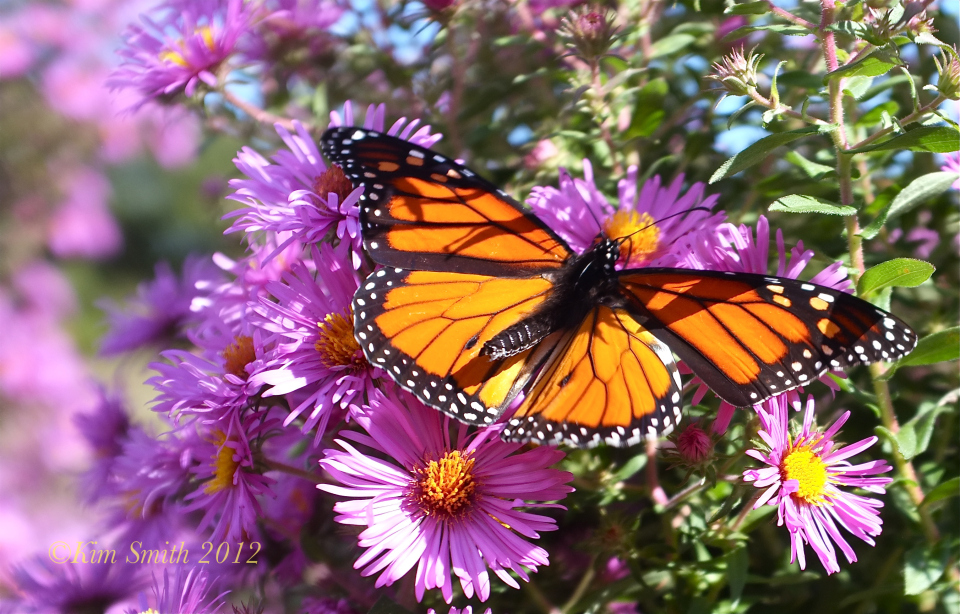
monarch-butterfly-c2a9kim-smith-2012-1Monarch Butterfly Nectaring at New England Asters

Harbor Walk Butterfly Garden ©Kim Smith 2012Gloucester HarborWalk Butterfly Garden

A Splash of Color for Winter Weary Eyes!

Cosmos ©Kim Smith 2014Cosmos bipinatus

In preparation for my upcoming season of programs, which are centered around designing gardens to support pollinators, one of my jobs is to refresh and update the photos that are an integral part of the presentation. This past month I have been immersed in colorful images and tomorrow I am giving my new monarch butterfly presentation at (the other) Cape. Here are some of the outtakes from my pollinator habitat programs for our winter weary eyes.

For more information about programs and upcoming events, please visit my website at kimsmithdesigns.com

Luna Moth Phlox DavidPhlox and Luna Moth

Sunflower and Joe-pye  ©Kim Smith 2014Sunflower and Joe-pye Weed

Goleta Monarch Butterfly Santa Barbara California Cape Honeysuckle ©Kim Smith 2015.Monarch Butterfly and Cape Honeysuckle, Goleta California

Cosmos -1 Donovan Field ©Kim Smith 2013

Monarchs Eyed for Possible Inclusion Under US Endangered Species Protection

Cape Ann Milkweed and Monarch Habitat, Eastern Point

The U.S. Fish and Wildlife Service is considering adding Monarchs as a threatened species under the Endangered Species Act. A one-year review is underway to monitor the butterfly’s status. Since the 1990s the population has plummeted from about one billion to approximately 35 million. That may seem like a substantial number, but the Monarchs need stronger numbers to be resilient to other threats such as harsh weather.

The reason for the decline is primarily because of loss of milkweed habitat in the agricultural heartland of the United States. With the development of Monsanto’s Roundup and Roundup Ready (glyphosate resistant) seed, farmers are now able to spray glyphosate directly on their corn, soybean, and sorghum crops. Roundup also destroys milkweed. Secondly, with the push for ethanol, farmers have begun to plant corn on conservation land.

If the Fish and Wildlife Service determines that the Monarchs are threatened, they will set aside land for milkweed.

You can read more about the the Monarch Butterfly Endangered Species Act here:

FAQs on the Monarch Butterfly Endangered Species Act Petition

Monarch Butterfly Wildflower Joe-pye ©Kim Smith 2012Monarch Butterfly Drinking Nectar from Native Wildflower Joe-pye Weed

You can learn more about the Monarch migration and the loss of Monarch habitat from Professor Tom Emmel here ~ 

Kim Smith Guest Speaker at the Rockport Garden Club Monday, October 6th

Rockport Garden Club ©Kim Smith 2014Sign Posted at the Rockport Community Center Garden

Next Monday afternoon at the Community House I will be presenting my “Pollinator Garden” program to the Rockport Garden Club. I am looking forward to meeting with this great group of civic-minded gardeners. I see their signs all around town at the various gardens they maintain and they do a simply outstanding job! The program begins at 1:15 and the doors open to the public at 1:00.

The Pollinator Garden

Following the rhythm of the seasons, celebrated landscape designer Kim Smith presents a stunning slide show and lecture demonstrating how to create a welcoming haven for bees, birds, butterflies, and other wildlife. Native plants and examples of organic and architectural features will be discussed based on their value to particular vertebrates and invertebrates.

Please visit the Programs Page of visit my website for a complete list of program offerings.

Whirling Butterflies (Gaura lindheimeri) ©Kim Smith 2014Whirling Butterflies (Gaura lindheimeri) at the Rockport Community House and Senior Center

Gaura is not a only a fabulous drought tolerant plant for the water-wise garden, it is also a caterpillar food plant for the beautiful day-flying White-lined Sphinx Moth.

Hummingbird-Hawk-Moth-Life-CycleGraphic Source: Animalbook.org

White-lined_sphinxAbove White-lined Sphinx Moth image courtesy wiki commons media.

The Rockport Community House is located at 58 Broadway, Rockport.

Crimson-eyed Rose Mallow

Niles Pond Gloucester ©Kim Smith 2014Niles Pond ~ Rose Mallow Natural Habitat

Reader Allen Sloane writes:

It was a pleasure to meet and talk with you on Saturday.

Thanks for all the info on poke weeds. My dog doesn’t seem to have any interest in the berries so some day I’ll get around to removing it.

Last night I went to look at it and right next to it is this plant which has decided to blossom. I have seen a couple of other plants in the neighborhood so I don’t know if they are from seed or it is a cultural decision to grow them. Be my guest if you want to answer via your daily post.

OLYMPUS DIGITAL CAMERAAbove photo courtesy Allen Sloane

Hi Allen,

The gorgeous flower in the photo that you sent is the North American native Hibiscus moscheutos, also known by many common names, including rose mallow, swamp mallow, eastern rosemallow, and crimson-eyed rose mallow. Crimson-eyed rose mallow blooms in shades of pure white to cheery pink and deepest rose red.

To answer your question, the seeds are dispersed by birds, and they are also readily available in nurseries. Locally, Wolf Hill always has a lovely selection. I plant rose mallows widely in my client’s native plants gardens as well as in Arts and Crafts period gardens because they are beautiful, easily tended, and are a terrific source of nectar for ruby-throated hummingbirds. H. moscheutos grow beautifully along marsh edges as well as in gardens. There’s a sweet patch growing at Niles Pond, and I am sure we would see many more if phragmites weren’t supplanting all our marsh wildflowers.

We planted a patch at the HarborWalk, but sadly they were stolen. Next year I am hoping we can replace the lost plants!

Rose Mallow Marsh Mallow ©Kim Smith 2013Rose Mallow Growing at Niles Pond

The following is an excerpt from an article that I wrote awhile back, titled “Growing Native:”

Crimson-eyed Rose mallow ©Kim Smith 2010Crimson-eyed Rose Mallow

“…Throughout the American Arts and Crafts movement, and well into the 1930’s, home and garden magazines, among the most influential sources of ideas for the homeowner, espoused the use of native plants in the landscape. Perhaps the most notable was Gustav Stickley’s The Craftsman, which was published for fifteen years, beginning in 1901. Stickley revered the North American white oak (Quercus alba), admiring it for its majestic role in the eastern forest and for its unique strength and figuring of the wood for furniture making. A sense of connectedness to nature is at the heart of the ideals of the Arts and Crafts movement and the popular writing of the era reflects how to create this relationship.

I am reminded of a lovely and memorable cover of Country Living for the September 1905 issue featuring a drift of rose mallows (Hibiscus moscheutos), which resemble and are closely related to hollyhocks (Alcea rosea). Both are members of the Malvaceae or Mallow Family. Hibiscus moscheutos are commonly referred to as crimson-eyed rose mallow and also marsh mallow, because the roots were used to make marshmallows. Rose mallows are a practical and economical native perennial as they reliably return year after year, unlike hollyhocks, although charming and beautiful, are short-lived (with the exception of Alcea rugosa). Rose mallows bloom in shades of pale pink to deeper rosey pink, from July through the first frost. Although found growing in marshy areas along stream and river banks, rose mallows will flourish in the garden when provided with rich moist soil and planted in a sunny location. New growth is slow to emerge in the spring. When cutting back the expired stalks after the first hard frost of autumn, leave a bit of the woody stalk to mark its spot for the following year. The leaves of Hibiscus moscheutos are a host plant for the Gray Hairstreak butterfly and the flowers provide nectar for Ruby-throated hummingbirds.”


Dedication of the Pathways Butterfly Garden

Caroline Haines butterfly garden Patheways for Children ©Kim Smith 2014Carolin Haines on ukelele singing with the Pathways Children “The Garden Song,” written by David Mallett 

Pathways for Children butterfly garden ©Kim Smith 2014

The dedication of the new butterfly garden at Pathway’s for Children was celebrated with speeches of thanks, and a song and poem performed by the Pathways children. The sun was shining, the bees and butterflies were on the wing, and there were lots of smiles of joy on the faces of the children and attendees. My most heartfelt thanks and deepest appreciation to all who have given so much to make the garden a success! Pathways for Children butterfly garden -3 ©Kim Smith 2014

Pathways for Children butterfly garden -4 ©Kim Smith 2014Just some of the wonderful people who made the garden possible: Andrew, Bernie Romanowski, Beth Graham, and Peter Van Demark. 

Pathways for Children butterfly garden sunflower ©Kim Smith 2014

Pathways for Children butterfly garden before ©Kim Smith 2014Before Photo Pathways for ChildrenPathways for Children butterfly garden -8 ©Kim Smith 2014

Pathways for Children butterfly garden -7 ©Kim Smith 2014

See previous post on the new butterfly garden at Pathways here: HOORAY FOR PATHWAYS FOR CHILDREN’S BRAND SPANKING NEW BUTTERFLY GARDEN

Please Don’t Weed the Milkweed

Common Milweed Asclepias syriaca ©Kim Smith 2014Once established, native Common Milkweed grows vigorously and rambunctiously, making itself known even in the thinnest of sidewalk cracks. Here’s a patch growing along East Main Street. I think it beautiful! What do you think?

*    *    *

If you caught Tom Ashbrook’s On Point broadcast on NPR yesterday morning you heard Doctor Lincoln Brower, Karen Oberhausser, and Rick Mikula, three of the world’s leading butterfly experts, speaking about the disappearance of the Monarch and the main reason why–most notably because of the sterilization of the American landscape through the use Monsanto’s Roundup and GMO corn and soybean crops.

The following is a list of a few suggestions on ways in which we can all help turn the tide:

Plant milkweed and wildflowers. Teach members of your family and friends what milkweed looks like and why we don’t want to weed it out of the garden. The above patch of milkweed is growing next to a shop on East Main Street. About a month ago, I went into the store and, very, very politely inquired as to whether or not they knew that the plant growing outside their doorway was a terrific patch of milkweed. They had no idea. I explained what the benefits were to the Monarchs and have since noticed that the milkweed patch is still growing beautifully!

Ban GMO crops. Genetically modified seeds have been altered to withstand megadoses of Roundup. Millions and millions of tons of herbicides are poured onto Roundup Ready fields of crops, preventing any other plant that has not been genetically altered from growing (in other words, wildflowers). The application of Monsanto’s deadly destructive herbicide Roundup is creating vast sterilized agricultural wastelands, which will, over time, only need heavier and heavier does of their lethal chemicals to continue to be viable.

Don’t apply herbicides and pesticides in your own gardens.

Create wildflower corridors in backyards and highways.

Reduce salt wherever possible (and where it wouldn’t cause harm to human life). Large amounts of road salt, as was needed during this past snowiest of winters, is detrimental to wildlife habitats.

Hooray for Pathways for Children’s Brand Spanking New Butterfly Garden!

Pathways for Children we ©Kim Smith 2014HOLY CANNOLI and WOW–look how beautifully the Pathway’s Staff is taking care of their brand new one-month old butterfly garden–every plant looks well-loved!!!Pathways for Children Butterfly Garden ©Kim Smith 2014 copy

Pathways for Children Butterfly Garden BEFORE ©Kim Smith 2014 copy

Spring 2014 Before Photo

Pathways for Children Butterfly Garden  After ©Kim Smith 2014.

Same View After July 18, 2014

Elizabeth's Toad ©Kim Smith

Toads Welcome!

My sincerest thanks to Caroline Haines for her vision to create a butterfly garden for the children at Pathways.

Thank you to the many donors who have made the butterfly gardens at Pathways possible.

Thank you to the Manchester Garden Club for their tremendous assisitance in planting the garden.

Thank you to the volunteers from Liberty Mutual for tearing out the old plantings.

And special thanks to Bernie Romanowski, Pathways for Children facilities director, for all his hard work and his extraordinary care and attention to detail, from the project’s inception through its continued maintenance. Pathways for Children Butterfly Garden Zinnia ©Kim Smith 2014. Pathways for Children Butterfly Garden Sunflower ©Kim Smith 2014. Pathways for Children Butterfly Garden Milkweed ©Kim Smith 2014.Common Milkweed (Asclepias syriaca) ~ Notice the pretty moth nectaring from the milkweed in the upper right.

The gardens are alive with pollinators of every species imaginable, including butterflies, bees, hummingbirds, songbirds, moths, and sundry insects! Bernie Romanowski ©Kim Smith 2014 copy

Bernie Romanowski

Manchester Garden Club at Pathways ©Kim Smith 2014

Manchester Garden Club

*     *     *

Antennae for Design ~

The picnic table and trellis were designed to be stained a classic seaside blue. Why would we want to paint or stain the trellis and not simply allow it to gain a weathered patina? From an aesthetic point of view, the wood used for both the picnic table and trellis are two different types and will age very differently from each other. If this were a very large garden, it wouldn’t matter so much, but in a cozy garden room such as this, the difference will become quite noticeable and unappealing over time. Additionally, the blue will offset the flowers and foliage handsomely and is a cheery choice with children in mind.

From a very practical standpoint, untreated wood will quickly degrade in our salty sea air and neither piece will last more than ten years without protection. An opaque stain is the best solution because as the trellis and picnic table age, the obvious differences in wood will be disguised. An opaque stain also requires the least amount of effort to maintain over time. The architectural details were designed to be a coordinated focal point in the garden. Many, many have donated their time and provided generous funding to the garden and hopefully, the integrity of the garden’s design will continue to be honored by all. Rotting untreated trellis ©Kim Smith 2014The above is a photo of an untreated trellis, allowed to weather, and was installed approximately ten years ago. _DSF8394 Pathways for Children Butterfly Garden school bus ©Kim Smith 2014.
Related Posts:

On Behalf of Pathways for Children and Myself ~ Thank You to the Beautiful Manchester Garden Club Ladies!!!

Huge Hugs and Ninety-Nine Thank Yous to the Amazing and Super Hard-Working Friends of the HarborWalk Crew

Thank you to our most awesome crew today. We had friends from as far away as Spain (the Ryan’s cousins), Rosemary Banks from Boca Raton, and Kim from Medford, all lending a hand with the gardens today and it was a joy to meet you all. And special thanks to our Gloucesterites Maggie Rosa, Ed, Catherine, George, Charles, Lisa Smtih, April, and Sam.

Friends of the HarborWalk Gloucester ma © Kim Smith 2014

On Behalf of Pathways for Children and Myself ~ Thank You to the Beautiful Manchester Garden Club Ladies!!!

Manchester Garden Club at Pathways ©Kim Smith 2014After months of planning and coordinating, this week we installed the new butterfly garden at Pathways for Children. We’ll be bringing you more updates from the garden but wanted to first thank our super hard-working, fabulous and fun, beautiful team of volunteers from the Manchester Garden Club. We planted the garden in record time due to their can-do-attitudes.  Thank You Ladies–you were simply the BEST!!!

And, success! As Bernie Romanowski, the facilities director, and I were tidying up, not one, but two butterflies stopped by to investigate the new garden, a Cabbage White and a Canadian Tiger Swallowtail. I wished our volunteers had seen that! Plant and they will come!

Thank You to Everyone Who Participated in This Year’s Cape Ann Milkweed Project!!!

Monarch Butterflies Pink New England Aster ©Kim Smith 2012Monarch Butterflies Nectaring at Pink New Enlgand Aster, Gloucester

Thank you so much to our most awesome community for participating in the Cape Ann Monarch Milkweed and Aster Project. Today was a huge and wonderful success and we were non-stop with folks dropping in to pick up their seeds and learn more about how they can help the Monarchs. Thank you, thank you, thank you!!!

And my most heartfelt thanks to Joey. He nudged me into doing the sale again this year by inquiring just about a month ago if we were planning a repeat of last year’s plant sale. Joey’s hospitality and interest in everyone who stops by makes Captain Joe’s a wonderfully fun place to have a community event!

Note to anyone who could not pick up their seeds or who was planning to have them sent via a self-addressed stamped envelope: You will recieve an email with information on where to send the check and order amount total. Thanks again to everyone!

Monarch Butterfly fur ©Kim Smith 2012Fun fact about butterflies: Butterflies do not grow fur. The fur-like structures that you see on butterflies are many single cells conjoined to form one long string.

*     *     *

In case you misplace the instructions on how to prepare your milkweed seeds for spring planting ~

How to Vernalize Milkweed Seeds for Spring Planting

Seeds of most temperate plants need to be vernalized—in other words, exposed to cold temperatures. The best way to vernalize is by stratification, which means subjecting seeds to a cold and moist environment for a short period of time. By stratifying, the seed’s natural break of dormancy that occurs when the seed spends the winter in the ground is simulated.

#1 Method of Stratifying Milkweed

Open the bag of seeds and place them between very slightly moistened paper towels in a plastic bag in the refrigerator. After vernalizing for 3-6 weeks, the seeds can be planted out in the garden in warm 70º soil.

#2 Method of Stratifying Milkweed

Place ¼ cup of sand mixed with ¼ tsp. of water in a plastic bag. Add the seeds and mix again. Store in plastic bag in the refrigerator. After vernalizing for 3-6 weeks, the seeds can be planted out in the garden in warm 70º soil.

Prepare the planting bed in a sunny location. Scatter seeds, or plant in rows, and cover with no more than ¼ inch of soil.

For natural vernalization, sow collected seeds directly into a prepared bed in the fall and the seed will germinate the following spring.

Monarch Caterpillars Common Milkweed ©Kim Smith 2012Monarch Butterfly Caterpillars Munching on Milkweed

Reminder: Monarch Milkweed and Aster Seed Pickup and Information Day is Next Sunday, May 18th, from 9:30 to Noon

male-female-monarch-butterfly-marsh-milkweed-2-c2a9kim-smith-2012-copyMale and Female Monarch Butterfly on Marsh Milkweed (Asclepias incarnata)

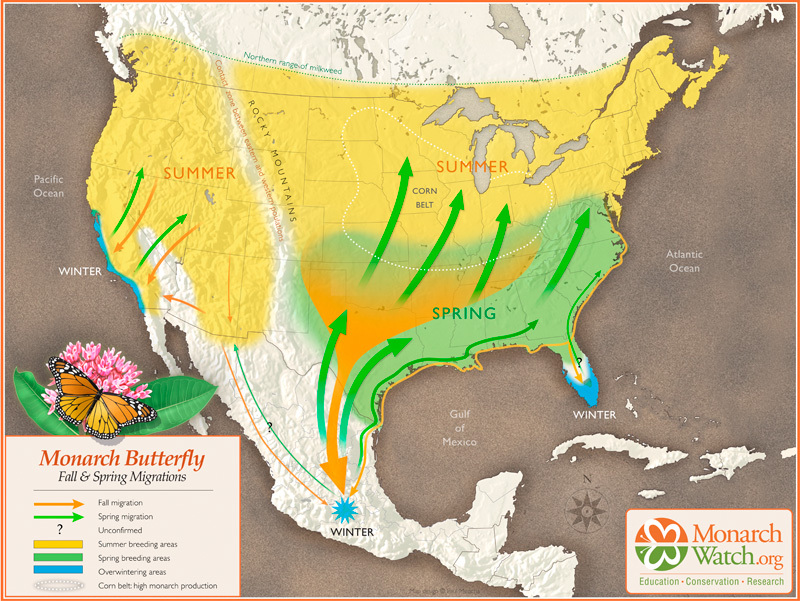
Where are the Monarchs today in their northward migration? They have spread throughout the Great Plains and Southern States. Some have already been sighted as far north as Michigan and Wisconsin!

Monarch Migration Map

Our Milkweed and New England Aster seed pickup day is next Sunday from 9:30 to noon at Captain Joe and Sons. Captain Joe’s is located at 95 East Main Street and you can find directions posted on their website here. Thank you so much to Joey for offering to host the event at the dock. See You There!

monarch-new-england-aster-c2a9kim-smith-2013Monarch Butterfly and New England Aster

Top Ten Tips for Attracting and Supporting Native Bees

Bees, butterflies, and songbirds bring a garden to life, with their grace in movement and ephemeral beauty.Bee and Monarch Butterfly ©Kim Smith 2012

Many of the plants that are the most highly attractive to butterflies are also the most appealing to bees, too!

Bees are also a “keystone organism,” which means they are critical to maintaining the sustainability and productivity of many types of ecosystems. Without bees, most flowering plants would become extinct, and fruit and seed eating birds and mammals (such as ourselves) would have a much less healthy and varied diet.

Native bees come in an array of beautiful colors, size, and shapes. Some are as small as one eighth of an inch and others as large as one inch. They may wear striped suits of orange, red, yellow, or white, or shimmer in coats of metallic iridescene. Their names often reflect the way in which they build their nests, for example, carpenter bees, leafcutter bees, mason bees, plasterer bees, digger bees, and wool carder bees.

Approximately 4,000 species of native bees have been identified north of Mexico. They are extremely efficient pollinators of tomatoes, apples, berries, pumpkins, watermelons, and many other crops.

Native Bee Pollinating Apricot Tree ©Kim Smith 2009Native Carpenter Bee and Apricot Tree

Listed below are what I have found to be the most successful tips for supporting and attracting native bees to your garden.

1). Choose plants native to North America. Over millennia, native bees have adapted to native plants. If planting a non-native plant, do not plant invasive aliens, only well-behaved ornamentals.

2). Choose non-chemical solutions to insect problems, in other words, do not use herbicides or pesticides.

3). Choose plants that have a variety of different flowers shapes to attract a variety of bees, both long-tongued and short-tongued bees.

4). Avoid “fancy” plants, the hybrids that have been deveolped with multiple double frilly layers. This only confuses bees when they are looking for nectar and gathering pollen.

5). Provide a succession of nectar-rich and pollen bearing blooms throughout the growing season. Select plants that flower during the earliest spring, during the summer months, and until the first hard frost.

6.) Plant a clover lawn, or throw some clover seed onto your existing grass lawn to create a mixed effect.

7.) Bee Friendly–bees only sting when provoked. When encountering an angry bee, stay calm and walk away slowly.

8.) Plant lots of blue, purple, and yellow flowers, a bees favorite colors.

9). Provide a source of pesticide-free water and mud in your bee paradise.

The first nine tips are for any garden, large or small. The last is for people with larger land areas.

10). Establish hedgerows, or clumps of native woody shrubs and trees, and wildflower fields. Contact the USDA NRCS (Natural Resources Conservation Services) for available funding opportunities.

Tomorrow I’ll post our top ten native plants for attracting and supporting native bees.

Cornus alternifolia ©Kim Smith 2009One of the most elegant of all native trees is the not-widely planted Cornus alternifolia, or Pagoda Dogwood. Where ever I plant this tree of uncommon grace and beauty it becomes a magnet for all manner of bees and butterflies.

My Film at the Lowell Film Festival April 29, at 6:30pm!

BST Banner FINALI hope you can come join me for an evening of screenings and Q and A at the 2014 Lowell Film Series. My film Life Story of the Black Swallowtail is playing, along with Whales of Gold, a film by Lucia Duncan, about the gray whale migration and how to conserve habitat and species in a way that also sustains the livelihoods of local people.

About the film: Life Story of the Black Swallowtail Butterfly is a 45-minute narrated documentary that takes place in a garden and at the sea’s edge. Every stage of the butterfly’s life cycle is experienced in vibrant close-up, from conception to pupation to metamorphosis. The film is for adults and for children so that all can gain a deeper understanding of the symbiotic relationship between wildflowers and pollinators and the vital role they play in our ecosystem. Filmed in Gloucester, Massachusetts.

The location of the screening is at the Lowell National Historical Park Visitor Center, 246 Market Street, Lowell. Click this link to read more about the series.

The 2014 Film Series: Land, Air, and Water is offered in partnership by the Lowell Film Collaborative and the Lowell Parks and Conservation Trust.

Click here to visit the film’s website: Life Story of the Black Swallowtail Butterfly

black-swallowtail-habitat-good-harbor-beach-gloucester-ma-© kim-smith-2011-copyBlack Swallowtail Habitat ~ The Wildflower Meadow at Good Harbor Beach

BomBom Butterflies, Voted People’s Choice Award Rockport Short Film Festival 2013

Antennae for Design: Native Flowering Dogwood

white dogwood cornus florida © Kim Smith 2013Currently I am working like mad on design projects, both creating new gardens and organizing existing gardens. Along with butterfly and pollinator gardens, I design many different types of gardens, including fragrant gardens, night gardens, children’s gardens, and seaside gardens. One of my favorite aspects of the design process is creating the horticultural master plan, which is typically done after discussing the clients needs, hopes, and aspirations for their garden, and created when working on the plan drawings.

While working on planting plans, I thought our GMG readers would benefit from suggested plantings and illustrated design tips. I started this series awhile back and called it Antennae for Design, and still like that name.

Cornus florida rubra @ Kim Smith 2012 copyIn designing gardens the first step is always creating the framework and trees comprise a major componenet in establishing the framework, or bones, of a garden. Trees provide a welcome sense of shelter with the shifting light and shadows filtering through the ever-changing ceiling. Fragrance, flowers, the shelter they provide, form, and texture of the leaves are not the only attributes of a tree garden. During the winter months there is the elegant beauty of pure line, the beauty of the branch.

Cornus florida rubra pink dowood © Kim Smith 2012 copyFor a multitude of reasons, one of my top choices when planting a tree-garden is our stunning native American dogwood (Cornus florida), both white and pink flowering forms. The fresh beauty of its spring blossoms, horizontal level branches, myriad pollinators attracted to the tiny florets, and the elegance of its bare limbs in winter are just some of the reasons why I love this tree! For a night garden especially, the white flower bracts are especially luminous in the moonlight. And, the American dogwood is also a larval food plant for the diminutive Spring Azure butterfly’s caterpillar!

white dogwood cornus florida ©kim Smith 2013 copyOh Garden of Fresh Possibilities! ~ Notes from a Gloucester Garden is available at my publisher’s website, click here.

ORDER YOUR MILKWEED SEEDS TODAY!

Monarch Caterpillars Eating Common Milkweed ©Kim Smith 2012JPGMonarch Caterpillars Munching on Milkweed

Ordering information:

Please note that the milkweed seeds are available in two different species and two different quantities. Please place your order amounts in the comment section of this post as follows:

Your Name, Your Email Address (optional), and Seed Type and Quantity.

For Example:

Pippi Longstocking, villavillakula@gmail.com

1 Packet Common Milkweed 3.50

1 oz. Marsh Milkweed 15.00

2 Packets Pink New England Aster @ 3.50 ea. = 7.00

My order total: $25.50

We are not collecting money ahead of time for the seeds. The orders are placed entirely by the honor system. Last year we did not have a single stiff and I will accept cash or check at the time of pick up. Seed pick up and information day will be Sunday, May 18th, from 9:30 to noon, at Captain Joe and Sons.

The packets of milkweed seeds (200-300 seeds) are perfect for a relatively smallish patch.

The larger ounce quantity is ideal for planting larger areas. On average, plan on 50 seeds per square foot. If your patch is 10 feet x 10 feet, that equals 100 square feet, and would require approximately 5,000 seeds.

Additionally, we are also offering pink and purple New England aster seeds. I’ve never grown New England asters from seed, but have read that they are relatively easy to start (although slow to germinate). New England asters make a beautiful border and will not only offer sustenance to southward migrating Monarchs, but in late summer also provide nectar for myriad species of bees and butterflies.

SEEDS

Common Milkweed (Asclepias syriaca)

Seed Packet (300 seeds) 3.50

1 ounce (4900 seeds) 12.00


Marsh Milkweed (Asclepias incarnata)

Seed packet (200 seeds) 3.50

1 oz. (5,200 seeds) 15.00


Pink New England Aster (Aster novae-angliae variation)

Seed Packet (1000 seeds) 3.50


Purple New England Aster (Aster novae angliae)

Seed Packet (1750seeds) 3.50

*    *    *

Why is it so important to plant milkweed for the Monarchs? Milkweed is the only food plant of the Monarch butterfly caterpillar. The Monarch butterfly migration is in serious peril due to loss of habitat in the United States by the use of Monsanto’s genetically modified Roundup Ready corn, soybean, and sorghum crops. Global climate change is also a factor in the weakening migration. We can all help mitigate some of the destruction by planting milkweed and nectar-rich wildflowers.

Common Milkweed (Asclepias syriaca) is the milkweed we see most typically growing in our dunes, meadows, roadsides, and fields. It grows quickly and spreads vigorously by underground runners. This is a great plant if you have an area of your garden that you want to devote entirely to milkweed. It prefers full sun, will tolerate some shade, and will grow in nearly any type of soil. The flowers are dusty mauve pink and have a wonderful honey-hay sweet scent.

monarch-caterpillars-common-milkweed-c2a9kim-smith-2011Common Milkweed and Monarch Caterpillars J-shape

Marsh Milkweed (Aclepias incarnata) is more commonly found in marshy areas, but grows beautifully in gardens. It does not care for dry conditions. These plants are very well-behaved and are more clump forming, rather than spreading by underground roots. The flowers are typically a brighter pink than Common Milkweed.

Monarch Butterfly marsh Milkweed ©Kim Smith 2012Marsh Milkweed and Monarch Butterfly

New England Aster (Aster novae-angliae) is a hardy late summer perennial that grows approximately 36 inches to 60 inches. New England asters prefer wet to medium soil, grow well in full sun, and will tolerate part shade.

New England Aster and Monarch Butterfly ©Kim Smith 2014Monarch Butterfly Nectaring at New England Aster

The Year the Monarch Didn’t Appear

Many, many friends have forwarded the following article from the New York Times, “The Year the Monarch Didn’t Appear.” 

Female Monarch Egg Marsh Milkweed ©Kim Smith 2013JPGFemale Monarch Depositing an Egg

In the above photo, the female Monarch Butterfly is curling her abdomen around to the underside of the Marsh Milkweed plant. She chooses the most tender foliage toward the top of the plant on which to deposit her eggs.

Begin New York Times article, published November 22, 2013 ~

ON the first of November, when Mexicans celebrate a holiday called the Day of the Dead, some also celebrate the millions of monarch butterflies that, without fail, fly to the mountainous fir forests of central Mexico on that day. They are believed to be souls of the dead, returned.

This year, for or the first time in memory, the monarch butterflies didn’t come, at least not on the Day of the Dead. They began to straggle in a week later than usual, in record-low numbers. Last year’s low of 60 million now seems great compared with the fewer than three million that have shown up so far this year. Some experts fear that the spectacular migration could be near collapse.

“It does not look good,” said Lincoln P. Brower, a monarch expert at Sweet Briar College.

It is only the latest bad news about the dramatic decline of insect populations.

Another insect in serious trouble is the wild bee, which has thousands of species. Nicotine-based pesticides called neonicotinoids are implicated in their decline, but even if they were no longer used, experts say, bees, monarchs and many other species of insect would still be in serious trouble.

That’s because of another major factor that has not been widely recognized: the precipitous loss of native vegetation across the United States.

“There’s no question that the loss of habitat is huge,” said Douglas Tallamy, a professor of entomology at the University of Delaware, who has long warned of the perils of disappearing insects. “We notice the monarch and bees because they are iconic insects,” he said. “But what do you think is happening to everything else?”

A big part of it is the way the United States farms. As the price of corn has soared in recent years, driven by federal subsidies for biofuels, farmers have expanded their fields. That has meant plowing every scrap of earth that can grow a corn plant, including millions of acres of land once reserved in a federal program for conservation purposes.

Another major cause is farming with Roundup, a herbicide that kills virtually all plants except crops that are genetically modified to survive it.

As a result, millions of acres of native plants, especially milkweed, an important source of nectar for many species, and vital for monarch butterfly larvae, have been wiped out. One study showed that Iowa has lost almost 60 percent of its milkweed, and another found 90 percent was gone. “The agricultural landscape has been sterilized,” said Dr. Brower.

The loss of bugs is no small matter. Insects help stitch together the web of life with essential services, breaking plants down into organic matter, for example, and dispersing seeds. They are a prime source of food for birds. Critically, some 80 percent of our food crops are pollinated by insects, primarily the 4,000 or so species of the flying dust mops called bees. “All of them are in trouble,” said Marla Spivak, a professor of apiculture at the University of Minnesota.

Farm fields are not the only problem. Around the world people have replaced diverse natural habitat with the biological deserts that are roads, parking lots and bluegrass lawns. Meanwhile, the plants people choose for their yards are appealing for showy colors or shapes, not for their ecological role. Studies show that native oak trees in the mid-Atlantic states host as many as 537 species of caterpillars, which are important food for birds and other insects. Willows come in second with 456 species. Ginkgo, on the other hand, which is not native, supports three species, and zelkova, an exotic plant used to replace elm trees that died from disease, supports none. So the shelves are nearly bare for bugs and birds.

Native trees are not only grocery stores, but insect pharmacies as well. Trees and other plants have beneficial chemicals essential to the health of bugs. Some monarchs, when afflicted with parasites, seek out more toxic types of milkweed because they kill the parasites. Bees use medicinal resins from aspen and willow trees that are antifungal, antimicrobial and antiviral, to line their nests and to fight infection and diseases. “Bees scrape off the resins from the leaves, which is kind of awesome, stick them on their back legs and take them home,” said Dr. Spivak.

Besides pesticides and lack of habitat, the other big problem bees face is disease. But these problems are not separate. “Say you have a bee with viruses,” and they are run-down, Dr. Spivak said. “And they are in a food desert and have to fly a long distance, and when you find food it has complicated neurotoxins and the immune system just goes ‘uh-uh.’ Or they become disoriented and can’t find their way home. It’s too many stressors all at once.”

There are numerous organizations and individuals dedicated to rebuilding native plant communities one sterile lawn and farm field at a time. Dr. Tallamy, a longtime evangelizer for native plants, and the author of one of the movement’s manuals, “Bringing Nature Home,” says it’s a cause everyone with a garden or yard can serve. And he says it needs to happen quickly to slow down the worsening crisis in biodiversity.

When the Florida Department of Transportation last year mowed down roadside wildflowers where monarch butterflies fed on their epic migratory journey, “there was a huge outcry,” said Eleanor Dietrich, a wildflower activist in Florida. So much so, transportation officials created a new policy that left critical insect habitat un-mowed.

That means reversing the hegemony of chemically green lawns. “If you’ve got just lawn grass, you’ve got nothing,” said Mace Vaughan of the Xerces Society, a leading organization in insect conservation. “But as soon as you create a front yard wildflower meadow you go from an occasional honeybee to a lawn that might be full of 20 or 30 species of bees and butterflies and monarchs.”

First and foremost, said Dr. Tallamy, a home for bugs is a matter of food security. “If the bees were to truly disappear, we would lose 80 percent of the plants,” he said. “That is not an option. That’s a huge problem for mankind.”

Jim Robbins is a frequent contributor to The New York Times and the author of “The Man Who Planted Trees.”
 *  *  *

My note about milkweeds ~

Common Milkweed (Asclepias syriaca) is the milkweed we see most typically growing in our dunes, meadows, roadsides, and fields. It grows quickly and spreads vigorously by underground runners. This is a great plant if you have an area of your garden that you want to devote entirely to milkweed. It prefers full sun, will tolerate some shade, and will grow in nearly any type of soil. The flowers are dusty mauve pink and have a wonderful honey-hay sweet scent.

Marsh Milkweed (Aclepias incarnata) is more commonly found in marshy areas, but it grows beautifully in gardens. It does not care for dry conditions. These plants are very well-behaved and are more clump forming, rather than spreading by underground roots. The flowers are typically a brighter pink than Common Milkweed.

Easiest Method on How to Grow Milkweed From Seed

Lecture Wednesday Night at the Pepperell Garden Club: The Pollinator Garden

7- HW Summer ©Kim Smith 2012Gloucester HarborWalk

On Wednesday evening, November 13th, at 7 pm, I will be giving my program, “The Pollinator Garden,” for the Pepperell Garden Club. Following the rhythm of the seasons, I present a slide show and lecture demonstrating how to create a welcoming haven for bees, birds, butterflies, and other wildlife. Native plants and examples of organic and architectural features will be discussed based on their value to particular vertebrates and invertebrates. I hope you will come join me!

6- HW Great Spangled Fritillary ©Kim Smith 2012 copyGreat Spangled Fritillary at the Gloucester HarborWalk

Where Are All the Monarchs?

Monarchs usually arrive in our region by the first week in July and go through several brood cycles. This year, barely any arrived. The Monarch’s sensitivity to temperature and dependence on milkweed make it vulnerable to environmental changes. Since 1994, U.S. and Mexican researchers have recorded a steady decline in the Monarch population in their overwintering grounds, with 2012-2013 being the lowest recorded to date.

Monarch butterflies daybreak willow tree ©Kim Smith 2012

Temperature change and habitat loss affect breeding success and longevity. Dr. Chip Taylor, a leading Monarch researcher at the University of Kansas reports that the widespread adoption of GMO corn and soybean crops resistant to herbicides, along with with intensive herbicide use, coupled with the federal government’s incentivized expansion of corn and soy acreage for the production of biofuels have caused a significant drop in milkweed throughout the heart of the Monarch’s range. Lack of milkweed equals no Monarchs. “Monarch/milkweed habitat has declined significantly in parallel with the rapid adoption of glyphosate-tolerant corn and soybeans and, since 2006, the rapid expansion of corn and soy acreage to accommodate the production of biofuels,” Taylor wrote on May 29.

Monarch Butterfly Nectaring at Seaside Goldenrod ©Kim Smith 2011Monarchs Nectaring at Seaside Goldenrod

What can we do? Encourage conservation organizations that conserve Monarch habitat, plant milkweed, plant nectar plants, and raise caterpillars. Hopefully the weather next spring and early summer will be more conducive to the Monarch’s northward migration and breeding success, and if and when the Monarchs arrive, they will find our milkweed plants.

Monarch Butterflies New england Aster ©Kim Smith 2012Monarch Butterflies Nectaring at New England Asters

If anyone sees a Monarch, please email me at kimsmithdesigns@hotmail.com or leave a comment in the comment section.

Update: For more information, see previous GMG posts on Monarchs and Milkweed:

How Exactly is Monsanto’s Roundup Ravaging the Monarch Butterfly Population?

News Release: MONARCH WATCH ANNOUNCES ‘BRING BACK THE MONARCHS’ CAMPAIGN

Cape Ann Milkweed Project

GloucesterCast Podcast 4/25/13 With Guest Kim Smith

Gloucester HarborWalk Tulip Tree Image to Travel Around the World

Recently my friend Joey (the creator of Good Morning Gloucester, the blog for which I am a daily contributor) was contacted by The Field Museum in Chicago about a GMG post from May 2012. They were interested in acquiring an image of mine from a post about our beautiful HarborWalk Tulip Trees, planted at St. Peter’s Square.

Tulip Tree Gloucester HarborWalk ©Kim Smith 2012 copyTulip Tree at the Gloucester HarborWalk Butterfly Garden

The Field Museum is currently developing an engaging new scientific exhibition on the topic of Biomechanics that will debut in the spring of 2014.  Led by the curatorial efforts of Field Museum Curator of Zoology, Dr. Mark Westneat, the exhibition will explore the science of looking at living things as machines built by nature and evolution.  One of the topics presented includes wind and how the leaves of a tree change in the wind.

I selected Tulip Trees for the gardens not only because they have a lovely ornamental bi-color effect when the leaves catch the wind, but primarily because they have a storied connection to Gloucester history. Liriodendron tulipifera was one of the primary woods used for tall ship’s masts, and because much of the wood from which the CB Fisk organs are built is Tulip Poplar (thank you to Greg Bover for the information about the Fisk connection to tulip poplar!). Tulip Trees are also a caterpillar food plant for the Eastern Tiger Swallowtail butterfly!

See post about Tulip Trees ~ Welcome Tulip Trees!

Fields From Which Dreams Are Made

So many thanks to the Donovan Family for allowing me continued access to film and photograph B-roll for my Monarch film, at their beautiful…

Wildflower Field of Dreams

Donovan Wildflower Field & House ©Kim Smith 2013 copySkylar’s Field

Goldfinch and Cosmos ©Kim Smith 2013Male American Goldfinch Eating Seed Heads ~ click to view larger

Large file Juvenile Blue Heron & Cosmos Donovan ©Kim Smith 2013Juvenile Blue Heron

Sunflower Donovan Field ©Kim Smith 2013 copySunflower (Helianthus annuus)

Rare Footage of a Luna Moth Taking Flight

 Beauty on the Wing ~ A Luna Moth takes Flight

My friend James, the facilities director at Willowdale Estate, sent a photo of a newly emerged moth on Sunday afternoon. He initially thought it was a paper napkin stuck to one of the lampposts, but upon inspection, discovered that it was a Luna Moth (Actias luna). With high hopes the moth would still be there, I dropped everything and raced over to Willowdale to photograph and film the moth. It is not that the moths are particularly rare, but that they are most often seen in flight at night.  Lucky me, to have had such a wonderful encounter with one of the most beautiful moths in all the world!

The Willowdale Luna Moth is a male of the species; you can tell by his bushy and feathery plumosa (or antennae). The female’s antennae are more thread-like. Notice too, just before he takes flight, how his body vibrates, which helps warm and energize the wings in preparation for flying.

Luna moths are members of the Saturniidae, subfamily Saturniinae. With a wingspan of typically up to four and a half inches, atypically up to seven inches, they are one of North America’s largest moths. Luna Moths are most often seen in the earlier part of summer in our region; this Luna Moth encounter took place on August 11, 2013. Luna Moths, like all members of the Saturn family of moths, eclose without mouthparts. They emerge solely to mate and deposit eggs of the next generation and live for only about one week.

Luna Moth larvae (caterpillars) feed on wide variety of broadleaf plants and different geological populations of Luna Moths are adapted to different hostplants. Northernmost populations most often feed on white birch (Betula papyrifera). More southerly populations feed on persimmon (Diospyros virginiana), sweet gum (Liquidambar styraciflua), hickories (Carya), walnuts (Juglans), and sumacs (Rhus).

The damage done by Luna Moth caterpillars on host trees is never significant enough to harm the host trees. Please don’t spray your trees with pesticides or herbicides!

Male Luna Moth Actias Luna ©Kim Smith 2013

A note about the music playing in the background ~

Ave Maria, Ellens Gesang III, D. 839, No 6, 1852, was composed by Franz Schubert in 1852 and is a setting of seven songs from Walter Scotts epic poem The Lady of the Lake. Performed by Barbara Bonney.

Read More: Continue reading

Vining Around the Garden

For readers not yet aware, Vine is a free downloadable app for your cell phone. Vine allows you to make six-second continuously looping videos, which you can share instantly  to Twitter, FB, and Vine. I like Vine because it is so immediate, uncomplicated, and fun to use. Some people I follow on Vine are John McElhenny; his Vines are always interesting scenes taken in and around Gloucester, and also Amanda Mohan and Macklemore because their Vines are often super funny.

To read the caption, wave your cursor over the lower left-hand corner of each video.

Zinnia elegans

Bearss Lime Tree

Stepahnotis floribunda