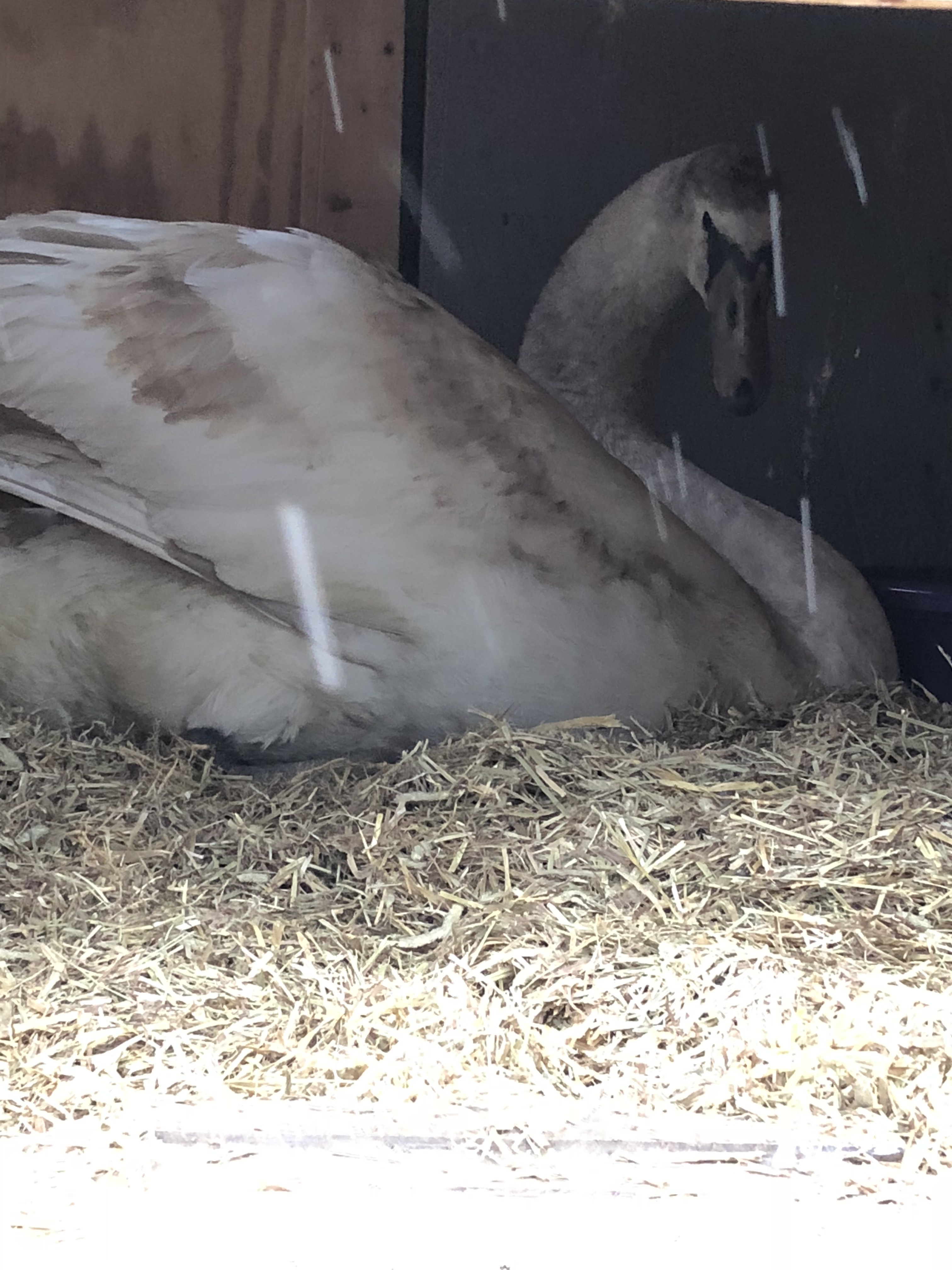
Not only collards, but kale, spinach and, Lyn reports, she is extra bananas for romaine lettuce, even trying to take them from Lyn’s hand! Lyn has added a fantastic improvement to the swan’s winter sanctuary and will update tomorrow when not so tied up with Christmas-making 🙂
Tag Archives: Cygnus olor
LYN SHARES A PHOTO OF THE THE YOUNG SWAN -SNUG AS A BUG :)
THE YOUNG SWAN GETS A SANCTUARY FIT FOR A PRINCESS (Or Prince?)
Joel and Skip Munroe arrived yesterday morning at Lyn’s home and the three spent the day continuing to modify the chicken coop-turned swan house-turned fantastic sanctuary (Joel is one of Mr. Swan’s caregivers and a carpenter). Lyn has generously added her dog’s run to extend the swan’s home, providing room enough for the Young Swan to stretch her wings and walk around within the enclosure.
Increasing the size of the enclosure.
Today, the very awesome landscaper Patrick Low, owner of JPL Landscape Solutions spent the morning modifying and attaching the (former) dog run to the chicken coop and securing the entire structure from predators such as coyotes and racoons. Pat, Joel, and Skip have very generously donated their time and services to creating the winter swan sanctuary.
Pat Low, creatively solving potential predator issues.
A friend of Lyn’s is donating three bales of hay. To supplement the pellets and corn Lyn has been feeding the swan, yesterday she purchased collard greens (which the Young Swan loved), spinach, and kale (yet to try).
We still do not know whether the Young Swan is male or female. Jodi Swenson kindly paid for the swan’s checkup at Dr. Cahill’s (with funds provided from her recent fundraiser) and Lyn has volunteered to pay for the DNA test. We should have the results back from the DNA test in several weeks. The Young Swan has a temporary name, TOS, an acronym for The Other Swan, but perhaps when we determine whether male or female we can give her a gender specific name, and possibly tie in a naming contest with a mini-fundraiser, to help defray the unexpected cost of taking care of her for the winter.
THE YOUNG SWAN GOES TO SEAPORT VETERINARY HOSPITAL
The Niles Pond Young Swan, rescued by Lyn Fonzo and Dan Harris on Friday, was taken to SeaPort Veterinary Hospital Saturday morning for a wellness checkup and because it is thought she may have contracted round worm at the shelter from where she originated. Dr. Cahill gave her a complete physical, checking on wings, feet, degree of fat on her bones, took an xray, and drew blood for a blood work up. His assistant also plucked a few feathers to send off to a lab to determine the sex of the young Mute Swan. It will take several weeks for the results of the tests, but based on Dr. Cahill’s visual assessment, she appears to be in excellent health!!
Swans can become very defensive when they feel threatened however, the Young Swan has a relatively speaking mild temperament. Lyn and Dan handled her with lots of tender care and caution and no one was bit during during transport and during the exam.
While we were at the vets, Joel Murnroe, one of Mr. Swan’s loyal caregivers, and a fine carpenter, was back at Lyn’s home modifying the chicken coop, with a larger entryway door and swan-sized rebuilt ramp.
The Young Swan has had an eventful and productive first day in captivity. With much gratitude and thanks to Lyn for taking on the tremendous responsibility of caring for a wild swan for the winter. Our hope is that the Young Swan is a she, and that she will be re-released to Niles Pond this coming spring.
1) Lyn Fonzo and Dan Harris, 2) Joel Munroe, 3) Dan Harris and the Young Swan
THE NILES POND YOUNG SWAN RESCUED BY LYN FONZO AND DAN HARRIS
Photos and video courtesy of Lyn Fonzo.
Eastern Point residents Lyn Fonzo and Dan Harris discovered the Young Swan frozen in the ice at Niles Pond early this morning. Dan reached into the water and scooped her up. She seemed relatively tame and did not try to bite Dan as we had imagined would happen. Dan and Lyn carried her to Lyn’s home, where she is currently living in one of Lyn’s chicken coops. Plans are underway to modify the chicken house to make it a bit more swan friendly. Joel Munroe, one of several of Mr. Swan’s caregivers, is also a carpenter and she is planning to help Lyn.
Tremendous shout outs to Lyn Fonzo, Dan Harris, Skip and Joel Munroe, and to Michelle Smith. West Gloucester resident Michelle formerly raised swans and emus on the family farm and she is providing excellent advice on how to care for swans in our New England climate.
New digs for the Young Swan
IS MR. SWAN TRYING TO SCARE THE BEJESUS OUT OF THE YOUNG SWAN?
Doesn’t this scene look brutal? It is a photo of Mr. Swan chasing the Young Swan.
The thing is, we think that this may be Mr. Swan’s way of encouraging the Young Swan to fly. If she is going to survive a New England winter in the wild, she has to move to saltwater coves and harbors. Niles Pond resident Skip Hadden has seen her fly but she seems to have no interest in leaving the Pond. Niles Pond is freezing over, and unless the Young Swan follows Mr. Swan’s lead, she will have to be relocated.
The Phoenix Rises
Mr. Swan is also know as Papa Swan and Buddy to his human friends, and The Boss-of-the-Pond to all avian creatures, from Rockport Harbor to Gloucester Harbor. He will be turning at the very least 28-years-old in 2018. We know this because a gentleman named Skip has been keeping watch over Mr. Swan, along with his first mate, second mate, and cygnets, beginning in the year 1992. A male Mute Swan cannot mate until he is a minimum of two years old and even that age would be considered unusually young.
When Mr. Swan lifts out of the water to stretch his wings as he is doing in the photo below, he reminds me of the story of the Phoenix in Greek mythology. Not only because he has lived a very long life of at least 28 years, which is extraordinary for a wild swan, but because he has an incredible ability to adapt to a constantly changing environment, and to rise from the depths of sorrow. He has survived near capture, physical injuries, boats in the harbors, coyotes, snapping turtles, and the loss of not one, but two mates. He was so deeply distraught after his second mate was killed by a coyote, many of us worried whether or not he would survive. But he has, and magnificently so.
Swan Lake
IS THE YOUNG SWAN AT NILES POND A BOY OR A GIRL?
Is the young Mute Swan at Niles Pond a male or female? Based on outward appearances, the simple answer is we don’t know yet. Notice that there is no pronounced black knob, or protuberance, at the base of the young swan’s bill. Our young swan only hatched in the spring of this year and has not reached puberty. The knob becomes prominent at about three years of age.
After swans reach maturity, it is easier to distinguish between the two sexes when they are side by side. The male’s knob, also called a blackberry, is larger than the female’s blackberry, and too, his neck is thicker.
In case you were wondering, the swan’s bill will begin to change color at eight to ten months and it will not turn completely orange until the swan is at least one year old.

Compare the difference between the male and female swan in the photo above. Mr. Swan, on the left, has a larger blackberry, thicker neck, brighter orange bill, and is overall larger. He is with is his second mate, Mrs. Swan, and the last cygnet they hatched together.
* * *
$22,765.00!!! RAISED FOR BEAUTY ON THE WING DOCUMENTARY! THANK YOU KIND DONORS!!!!!!!!!!!
WITH THE GREATEST APPRECIATION FOR OUR COMMUNITY OF FRIENDS AND SPONSORS, I AM OVERJOYED TO SHARE THAT TO DATE WE HAVE RAISED $22,765.00 FOR THE DOCUMENTARY FILM “BEAUTY ON THE WING” ONLINE FUNDRAISER!!!
Friends of the Monarch Butterfly: If you would like to help towards the completion of the documentary film Beauty on the Wing: Life Story of the Monarch Butterfly, please consider making a tax deductible donation here:
DONATE HERE
Donors contributing over $5,000. will be listed in the credits as a film producer.
For more information, visit the film’s website here: Monarch Butterfly Film
For an overview of the film’s budget, please go here: Budget
Thank you so very much for your help.
With gratitude,
Kim
MY DEEPEST THANKS AND GRATITUDE TO LAUREN MERCADANTE (PRODUCER), SUSAN FREY (PRODUCER), NEW ENGLAND BIOLABS FOUNDATION, BOB AND JAN CRANDALL, MARY WEISSBLUM, SHERMAN MORSS, JAY FEATHERSTONE, MARION F., ELAINE M., KIMBERLY MCGOVERN, MEGAN HOUSER (PRIDES CROSSING), NANCY MATTERN (ALBUQUERQUE), DONNA STOMAN, PEGGY O’MALLEY, JOEY C., CATHERINE RYAN, JOEANN HART, JANE PAZNIK BONDARIN (NEW YORK), ROBERT REDIS (NEW YORK), NUBAR ALEXANIAN, PETER VAN DEMARK, PATRICIA VAN DERPOOL, FRED FREDERICKS (CHELMSFORD), LESLIE HEFFRON, JIM MASCIARELLI, DAVE MOORE (KOREA), LILIAN AND CRAIG OLMSTEAD, JOHN STEIGER, PAT DALPIAZ, AMY KERR, BARBARA T. (JEWETT, NY), ROBERTA C. ((NY), MARIANNE G. (WINDHAM, NY), PAULA RYAN O’BRIEN (WALTON, NY), MARTHA SWANSON, KIM TEIGER, JUDITH FOLEY (WOBURN), PATTI SULLIVAN, RONN FARREN, SUSAN NADWORNY (MELROSE), DIANE LINDQUIST (MANCHESTER), HEIDI SHRIVER (PENNSYLVANIA), JENNIFER CULLEN, TOM HAUCK, AND ANONYMOUS PERSONS FOR THEIR GENEROUS HELP.
UPDATE ON MR. SWAN AND THE YOUNG ONE–COULD THEY POSSIBLY BE WARMING TO EACH OTHER?!?
After a summer of what appeared to be a not-so-happy pairing between Mr. Swan and the new one, the two seemed to have turned some kind of corner. Whether the truce is temporary or not, this morning the pair were observed preening within mere feet of each other and the young swan, actually nodded off, with Mr. Swan nearby.
For the sake of this story and in case a romance blossoms, we’ll call her a she. Friends of Mr. Swan have been reporting that he was either very aggressively biting and flying at her, chasing her into the reeds on the far side of the pond, or possibly chasing her to teach her to become airborne.
Mr. Swan has spent nearly the entire summer at Niles Pond, and he may never again return to Henry’s after the terrible debacle of his attempted capture. The day before the recent southeaster wind and rain event, Mr. Swan took off to Rockport Harbor and was seen there by his friends Lois, Joel, and Paul.
Paul St. Germain, via Lois, shares the above photo of Mr. Swan drinking water from a boat at Rockport Harbor.
The young swan softly crying.
I looked for the young swan at Niles Pond the day after the storm and much to my surprise she seemed very lonely. She was softly crying over and over again in much the same manner as I have filmed Mr. Swan when his mate was killed by a coyote several years ago. Her cries were quieter than his, but she definitely appeared to be searching, calling, and distressed.
Yesterday, Niles Pond resident Lyn reported that Mr. Swan had returned to Niles Pond. I’ll relate exactly what I observed this morning. The young swan was at the water’s edge, busily preening. Although she does not yet know how to fly, she certainly knows how to groom and maintain her flight feathers for future flying. Mr. Swan caught sight of me and began to swim straight towards us, with his feathers all busked out. She began to swim away from him as he was approaching and made it about thirty feet. He then flew directly towards her, but this time not in an aggressive way, but in a manner that herded her back to the shoreline. I was honestly very happy and relieved to see this because I really did not want to witness Mr. Swan attacking her again.
The soft colors of the first hatch year feathers matched the soft colors reflected off the water in the early morning light.
Both were now at the shoreline and both began to preen, only several feet apart, as if they had been doing this their whole life and it was the most normal interaction between them imaginable. I filmed them for a bit when the young swan grew tired of preening and fell asleep, with Mr. Swan keeping an eye out towards the water. Eventually Mr. Swan took off towards his friend Skip’s dock. She then awoke, but stayed behind near the shore.
Nodding off in close proximity to Mr. Swan
Are they becoming more comfortable with each other? Is the young swan a girl or a boy (too soon to tell from outward appearances)? Will the young swan ever learn to fly, or is there something wrong with her wings? So many questions and only time will tell. I hope so much both will survive the winter without coyote attack (or some other tragedy befalls them) and we will be able to observe as this new chapter in Mr. Swan’s life unfolds.
Mr. Swan in the Boston Globe!
Mr. Swan super stressed and panting while being chased around Henry’s Pond.
Mr. Swan Makes the Big Time in the Boston Globe!
In Rockport, Chasing Mr. Swan
Article by Boston Globe correspondent Emily Sweeney
Photos courtesy Kim Smith
A popular swan at Henry’s Pond in Rockport managed to stay one step ahead of rescuers who were trying to capture him Tuesday.
The elderly bird, known affectionately as “Mr. Swan,” has been a common sight at the pond for many years. During that time, he’s fathered many cygnets and outlived two of his mates, and led a peaceful existence on the water.
But things took a turn recently when Mr. Swan hurt his leg. Although he could still swim, some people began to notice that Mr. Swan was having difficulty walking. And they began to worry.
Soon enough, the Animal Rescue League was called in to help.
“The swan is considered a community pet, so the goal was to capture it, have it treated, and then returned to the pond,” said Michael DeFina, a spokesman for the Animal Rescue League.
While that mission sounds simple, carrying it out proved to be anything but. Catching Mr. Swan turned out to be an impossible task for the organization’s rescue team. Armed with large nets, the two rescuers — Bill Tanguay and Mark Vogel — used kayaks to pursue Mr. Swan on the water. At one point, Vogel almost caught Mr. Swan in his net, but the bird was able to break free.
Mr. Swan eventually sought refuge in the reeds, and the rescuers decided to call off the chase.
“The swan was stressed, and the soaring temperatures made him very tired,” said DeFina. “The fact he eluded capture and was able to swim without showing obvious signs of pain led to the conclusion that the injury may not be that severe.”
“After giving up the chase, ARL and the concerned parties agreed to continually monitor the swan’s condition, and if it worsens, ARL will be contacted to get the swan medical attention, and again, have him returned to the pond,” DeFina said.
Kim Smith, a Gloucester resident who counts herself among one of Mr. Swan’s many fans, described the rescue attempt as a “wild swan chase.”
“He was chased back and forth across the pond,” she said.
What made his escape even more impressive is Mr. Swan’s age. According to Smith, sightings of Mr. Swan date back to the early 1990s, which would make him at least 27 years old. (Smith knows Mr. Swan well: she’s spent the past six years filming him for a documentary film.)
“He’s an amazing creature,” she said.
DeFina said that the average lifespan for a swan in the wild can be about 10 to 15 years due to the hazards they can encounter (getting caught in fishing gear, getting hit by a boat, etc.), while a swan living in a protected environment can live 20 to 30 years.
“It’s clear that there are certainly people in Gloucester who care for this swan, if he’s in fact been around that long,” DeFina said.
Smith said that although the Animal Rescue League’s efforts were well-intentioned, she’s happy that Mr. Swan eluded capture.
“He’s lived this long, he deserves to spend his last days in his own neighborhood with his friends,” she said.
Long live Mr. Swan.
https://www.instagram.com/p/BVSBFcSl46P/
Emily Sweeney can be reached atesweeney@globe.com. Follow her on Twitter@emilysweeney.
Mr. Swan Capture Update #2
After suffering the extraordinary trauma of yesterday’s attempted capture, Mr. Swan was seen late in the day by friends, peeking his head out between the reeds. I stopped by to see him this morning at about 6:30, thinking perhaps I would catch a glimpse, and to my utter surprise he was sitting on the edge of the road that divides Pebble Beach from Henry’s Pond. Very deliberately, Mr. Swan was heading to the open ocean. He was obviously extremely weary from the effort, and from the previous day’s event, taking only a few difficult steps at a time, before plopping down, then a few steps more. Slowly and determinedly he made his way.
Crossing the road between Henry’s Pond and Pebble Beach
Friends Lois, Serena, and Skip Monroe stopped by to offer food and encouragement. After at least an hour of effort, he made it to the water’s edge and took off toward Niles Pond (it usually takes him about five minutes to cross the road).
Making his way through the super yucky red seaweed.
Shortly after we got a call from Lyn that Mr. Swan had arrived safely at Niles Pond. I stopped by Niles on my way to work to see him and he appeared so much happier and relaxed than earlier in the morning. A true survivor, he was gliding and preening and vocalizing. Long live Mr. Swan!
In regards to how old is Mr. Swan, I was reminded by another great Friend of Mr. Swan, Skip Hadden, that Mr. Swan is actually at least TWENTY SEVEN years old!! When Skip arrived at Niles Pond in 1992, Mr. Swan was an adult breeding male with a family (swans do not begin to breed until they are at the very least two years old).
Regarding Mr. Swan’s foot injury, Skip writes, “He has injured this foot in the past. He fell off our roof after crash landing there in turbulent winds circa 2000. Heartily agree in daily monitoring as he is one determined character. He has a strong chance of survival if left to his own devices and our small efforts to assist from a distance.”
Mr. Swan at Niles Pond this morning! I hope he chooses to stay here to recuperate.
Mr. Swan Capture Update
Despite repeated attempts by Boston Animal Rescue League workers Bill Tanguay and Mark Vogel to capture Cape Ann’s beloved swan, Mr. Swan escaped.
The day began a little after 6:00am when the Friends of Mr. Swan convened at Henry’s Pond to strategize on how to manage and understand the mysterious notice posted at the pond, which read, “Please don’t feed swan. He is being rescued on Tuesday.” The Friends of Mr. Swan are a group of people who feed and monitor Mr. Swan on a daily basis throughout the year and they include Skip Hadden, Lois, Serena, Skip and Joel Monroe, Lyn Fonzo, Elaine Somers, and myself. The news had spread quickly amongst the group about the scheduled rescue. Mr. Swan’s left foot appears to be sprained or in some way injured at the ankle (possible snapping turtle bite) but we had taken the tactic of allowing the foot to hopefully heal on its own. Wildlife capture can lead to euthanasia and that is truly the last diagnosis any of us would want for Mr. Swan (also known as Buddy, Poppa Swan, Old Blue Eyes, and Papa Swan).
Mr. Swan is at least 27 years old, has outlived two mates, and fathered many cygnets. With his beautiful blue eyes and pure white cygnet offspring, Mr. Swan is a rare form of Mute Swan (Cygnus immutabilis), thought to originate from the Baltic Sea region. All these many years that he has called Cape Ann home Mr. Swan has brought joy and happiness to countless people, especially to young children. At this point, he is not showing outward signs of physical pain, he is feeding and drinking, and maintaining his feathers (preening). We hope with all our hearts that his foot will heal but believe that if it his time to go, he should be permitted to live out his remaining days in his own neighborhood with his community of friends.
The Friends agreed to take turns watching for the ARL workers. Our objective was to speak with them to learn more about the specifics of the capture and how it would impact Mr. Swan’s overall health, what would be the various courses of action based upon veterinary examination, if we could determine the outcome with covering his medical bills, and to insure that Mr. Swan be returned to Cape Ann, if he did have to undergo rehabilitation.
ARL’s Bill and Mark arrived at around noon. We discussed the various options and were assured that as Mr. Swan is a community “pet,” with plenty of friends to look out for him, he would less likely be euthanized.
Coaxing Mr. Swan to the pond’s edge was easy when offered some favorite foods, but getting him to walk onshore was another story. Out came the kayaks, where Mr. Swan led Bill and Mark on a wild swan chase back and forth from one end of the pond to the other. He skillfully led the workers through the thick reeds of phragmites, where he has a secret nest and many avenues of escape. At one point it appeared as though Mark had captured him with the swan-sized net, but he wriggled out and bolted free. We could see Mr. Swan panting and visibly tiring and at that point he slipped deep, deep into the reeds and was not seen again. We all came to the mutual decision that it was best not to continue as Mr. Swan was clearly super stressed and exhausted.
Nearly captured!
Super stressed and panting after being chased around the pond numerous times.
Bill, Mark, and the Friends decided that the logical course of action is to continue to monitor Mr. Swan on a daily basis. If his condition worsens we will at that time call the ARL. In the meantime, we are urging everyone to please follow these simple guidelines in helping Mr. Swan on his road to recovery.
- A healthy diet while healing is critically important. He should only be fed cracked or whole corn. Additionally, chopped lettuce or grass cuttings can be offered along with the corn. PLEASE NO JUNK FOOD, which includes bread, chips, and every other kind of processed food snack.
- Please do not bring your pooch to the shoreline where Mr. Swan is resting. Dogs, especially bird chasing dogs, create a great deal of stress for swans.
- If you see Mr. Swan in any kind of distress please contact any one of the Friends of Mr. Swan or email me at kimsmithdesigns@hotmail.com
THANK YOU FOR YOUR HELP!
https://www.instagram.com/p/BVSBifPF3Hu/
You can’t miss the Red-winged Blackbirds at the pond and they love cracked and whole corn, too.
A Day in the Life of Baby Swans
Meet the Swan family. They live on a pond in Eastern Massachusetts. On an island in the middle of the pond, Papa and Mama built a nest made of cattails, reeds, and sticks. For six weeks Mama and Papa Swan took turns sitting on the nest warming, or incubating, the eggs.
Within hours of hatching, the baby swans, called cygnets, are mobile. Precocial refers to animal species in which the young are relatively mature from the moment of hatching. Within a day or two, Mama and Papa take the cygnets to water for their first swim.
Unlike songbirds, which are born naked, blind, and helpless, cygnets are born with downy soft feathers and with their eyes open. Piping Plovers are another example of a bird species that is precocial. The cygnets will soon outgrow the soft down.
A family of cygnets is called a clutch or brood.
Two week old swans are sleeping on the bank of the pond. Although cygnets are precocial and relatively independent, they are unable to regulate their body temperature. They rely on warmth from Mom and Dad, and from snuggling each other during nap time.
Cygnets absorb the last of their yolk into their tummies before hatching, which means they don’t have to eat for several days. Their first meal might be a nibble of an insect caught along the water’s edge.
The cygnets forage for insects and pond vegetation.

Precocial birds find their own food, occasionally with instructions from Mom and Dad.
See the little tiny V-shaped wing bud, tucked over the bill. Notice how much proportionately larger are an adult swan’s wings (below). Cygnet’s wings grow rapidly. They usually learn to fly by early fall, at about five months old.
Back to shore to preen and to warm up.
An adult swan’s bill has jagged, serrated edges that look like small teeth and are very sharp. Nesting swans can be very aggressive. They will hiss, puff out their feathers to appear larger, flap their wings, move very quickly when angered, and smash their body and wings at a perceived predator. Swans will bite and peck, too. Please keep a safe distance when observing swans, especially nesting swans.
Papa and Mama Swan need their rest, too.
MR. SWAN EMERGENCY
MR. SWAN EMERGENCY
Please share , thank you!
We Friends of Mr. Swan would like to know who posted the do not feed sign because there is a planned “rescue” of him, which is to take place tomorrow, Tuesday.
We are all aware of his injured leg, and expect that it will heal. If it does not heal, we will have a swan expert have a look at him and take him to Tufts, if needed.
To the well-intentioned person, Mr. Swan will be EUTHANIZED if he is rescued by the wrong group. Whoever is planning Tuesday’s rescue should be aware of the following information, passed on by Jodi Swenson, our region’s local bird rescue expert:
“Because he is non-native, Mr. Swan would have to go to New England Wildlife Center. But, if it is just a limp, or something like that, leave him alone because a hurt leg that won’t get better will make him non-releasable, and that means EUTHANASIA”
Please, please contact kimsmithdesigns@hotmail.com. THANK YOU.
Mr. Swan, filmed several days ago at Niles Pond. He is staying in the water, probably so as not to bear weight on his leg. He is eating fine and his feathers are well-groomed and in good shape, signs that he does not need to be rescued at this point. Also, in order to fly from Henry’s Pond to Niles Pond, he needs to run on his feet, otherwise he won’t become air born. Mr. Swan is well over twenty years old. If his leg is not curable, he deserves to live out his life in his own neighborhood with his friends.
Good Morning! Brought to You by the Sensational Mr. Swan
Glorious swan’s wings! In these photos you can see Mr. Swan’s magnificent new set of feathers.
Mr. Swan has resumed his habit of traveling from body of water to body of water within his territory. Why does he not travel during the summer months, primarily dwelling at Niles Pond? Swans molt each summer and during the molting period, they cannot fly.
Mute Swans molt when their cygnets cannot fly. The female (pen) begins to molt almost immediately after the young hatch. The male, or cob, waits until the female’s flight feathers have grown back completely. The reason for this staggered molting period is because swans use their wings in battle and to defend their young. The swan family will never be left defenseless with at least one of the pair’s set of wings fully functional. The molting period lasts anywhere from four to seven weeks.
Good morning! Mr. Swan’s big morning stretch before he sets off to patrol his territory
Mr. Swan Update
Swan Pair at Henry’s and Niles Ponds
A pair of swans was spotted at Niles Pond by my friend Lyn. I stopped by the Pond at 8:15 to have a look. They were on the far side of Niles, getting ready to take off and was only able to take a few quick photos. The pair flew overhead in the direction of Henry’s Pond. After doing the podcast with Joey and the wonderful Gloucester Stage Company cast, I raced over to Henry’s. In the meantime, the two had returned to Niles, but were chased away by our Mr. Swan. As I arrived at Henry’s they flew in!
The pair appear to be in their third year. This is evident by the patches of brown feathers and dullish pink bills, although the bill of the larger of the two is gaining a more coral-orange hue.
Note both have black eyes, unlike our rare and beautiful blue-eyed swan. I am hopeful that Mr. Swan will find a new mate and if we are fortunate, this newly arrived on the scene pair will decide to make Cape Ann their home too!
If you catch sight of swans at any of our area ponds or in the harbor, please write in and let me know. Thank you so much!
CAPE ANN’S RARE AND BEAUTIFUL BLUE-EYED MR. SWAN
Ol’ Blue Eyes
Recently, one of the very kind people who regularly feed our resident swan, Dominic Nesta, pointed out that Mr. Swan is unusual for his blue eyes. I was surprised by his comment because I’ve only ever filmed Mr. Swan, his deceased mate, and their offspring up close, and they all have (had) blue eyes. Aren’t all Mute Swans blue-eyed I wondered? After looking at hundreds of photos on Google images and reading dozens of descriptions, Mute Swans eyes appear as, and are always described as, black, whether they are the English Mute Swan or the Polish variant.
Mr. Swan is of the Polish kind. Polish Mute Swans are rarer, mostly pure white, and with pinkish gray feet, as opposed to the English sorts, which have black feet and legs. Hans Christian Anderson’s Ugly Duckling was perhaps logically written with the English Mute Swan cygnet in mind, which are typically dressed in a mottled gray downy coat. Polish Mute Swan cygnets are pure white. Until I learned the difference I wondered how there could ever be such a story as the Ugly Duckling because again, I had only ever seen Mr. Swan’s offspring, which have always been exceptionally beautiful perfect little balls of fluffy white down (gray cygnets aren’t ugly either, IMO).
Polish Mute Swans (Mrs. Swan and Cygnet, Henry’s Pond)
A pigment deficiency of a gene in the sex chromosomes is what causes the whiteness (leucism). Polish Mute Swans were given their name when in 1800 they were introduced to London from the Polish coast on the Baltic Sea. They were at first thought to be a new species because of their unchanging color form (Cygnus immutabilis).
Our Mr. Swan is extraordinary not only for his long-lived life of well over twenty years, but also for his sapphire blue eye color.
Help needed from our readers–do you have a pair of swans in your area? If so, please email me at kimsmithdesigns@hotmail.com. Thank you very kindly.
Looking to Spring!
HUGE THANK YOU TO THE ROCKY NECK ART COLONY!
So many thanks to everyone who came out for my talk at the Cultural Center last night. Thank you to old friends who were there and thank you to my new friends; it was a pleasure to meet you!
We had a wonderful turnout. The Cultural Center at Rocky Neck and the Rocky Neck Art Colony did a tremendous job hosting. With special thanks and gratitude to Martha Swanson, Suzanne Gilbert Lee, Jane Keddy, Karen Ristuben, Tom Nihan, and Mary Lou. The Beautiful Birds of Cape Ann thank you to!
Mr.Swan and Mallards Rocky Neck Gloucester
ON GOLDEN POND
WHEN SWANS DRINK SALTWATER, WHAT HAPPENS TO THE SALT?
Several weeks ago, in response to a question sent in by a reader that asked can swans drink seawater, we responded yes, because just above the eyes and under the skin, they have a gland that removes salt from their blood stream and concentrates it in a solution that is excreted from their nostrils. In the photo below, you can see sunlight coming through the nare holes, which are near the base of the bill. When the swan shakes its head, the salt is removed through the nares. Most species of birds have nare holes, which lead to the nasal cavity within the skull, which is part of the respiratory system.
Please join us Thursday night at the Cultural Center at Rocky Neck. For more information on my illustrated talk “Beautiful Birds of Cape Ann” visit this post here.
DO SWANS DRINK SALTWATER?
In the above photo you can see our super smart Mr. Swan drinking freshwater from snow melting on the roof above his head, which was running down the gutters and into the harbor.
Mute Swans mostly drink freshwater (and a great deal of it) because most of the places that you find swans living at are on freshwater ponds, lakes, rivers, and inlets. However, just above the eyes and under the skin, swans have a gland that enables them to drink saltwater. This gland removes salt from their bloodstream and concentrates it into a solution that is excreted from their nostrils, which the swan can shake its head to clear.
There are a number of good folks in Rockport and Gloucester who keep a watchful eye on our local swans. Thursday I had the joy of meeting Lois and Serena, who have been feeding and observing the swans for over twenty years. They have photos of Mr. Swan (known as Buddy in Rockport) dating from 1998. He was already full grown by then, which makes him at least twenty years old. That is quite extraordinary as most Mute Swans in the wild live on average only to twelve years of age.
My deepest thanks and appreciation to Lois and Serena for the time they took sharing swan stories, the reading material lent, and for their kind and goodhearted nature, especially towards Buddy/Mr. Swan!
As you may or may not have read, I have been filming the swans over the past several years for a film project. If you have a Cape Ann swan story that you would like to share I would love to hear from you. Please contact me at kimsmithdesigns@hotmail.com. Thank you so much!
MR. SWAN HAS A GIRLFRIEND!!
Could this be the new Mrs. Swan?
Note the young swan’s brownish feathers and greyish-pink bill (left). This tells us that she is not quite two years of age.
Today at 9:30am while out doing errands, I stopped by Niles Pond to see if I could find my brand new glove, which was lost the morning previously. That Monday, the day after the weekend storm, the mergansers had moved overnight to Niles Pond to escape the wind and waves on the harbor and I had captured footage of Mr. Swan with the Red-breasted Mergansers. Last I saw him, he was alone and circling the pond, plaintively calling.
Just as I got to the spot where filming yesterday I looked up and flying overhead were not one, but two swans! They were flying towards Brace Cove. I hurried back to my car to get cameras, checking all the while to see if the pair would stay at Niles or continue up the coast. They circled back around Niles before landing on the far side of the pond. The large pure white male looks like Mr. Swan and his girlfriend appears to be much younger as she is comparatively smaller and still has some brownish-gray cygnet feathers.
I immediately called my friend Lyn to let her know about the swan pair swimming at her end of the pond. There was a large patch of ice that prevented the swans from coming closer to where she was calling them from shore but we did have a good long look and we both agree it could very well be Mr. Swan (Lyn calls him Poppa Swan and in Rockport he’s known as Buddy).
The pair of swans stayed, feeding on pond vegetation and moving slowly through the icy waters. Swans use their powerful breast muscles in a lifting and lurching movement to break up ice. It takes a great amount of effort to cut a path through the ice and Mr. Swan is much more adept at ice breaking than is his new girlfriend.
By a swan’s second summer (in other words two years of age) it will have lost all the characteristics of an immature. The brown feathers are gradually replaced with the white feathers. The last thing to visibly change is the color of the swan’s bill. A cygnet’s bill is blue/grey changing over the two year period to pinkish and then orange. Swans can breed as early as two years of age although most don’t begin until three years.
I can’t saw with 100 percent certainty that this is Mr. Swan because I didn’t get a close look at the distinguishing marks on his bill however, all signs point in this direction.