Tuesday through Friday of this week I will be bringing you expert gardening advice excerpted from my book Oh Garden of Fresh Possibilities! Notes from a Gloucester Garden. My book is currently on sale on my publisher’s website (David R. Godine) for the unheard of price of 15.00 (the list price is 35.00.) In response to Godine’s super sale, I am offering a free copy of my book.
Leave a comment or question on any of the posts by Friday at 8PM to be entered into the drawing to win. Multiple entries are allowed. One person will be chosen at random. The book will be shipped on Monday, the 17th, which should allow time for it to arrive by Christmas. Shipping is included to addresses within the United States and Canada.
Praise for Oh Garden! from The Boston Globe’s Carol Stocker ~ Oh Garden! is a treasure, and perhaps the best garden gift book of the season. Both dream-like and practical, it captures the gardener’s journey by integrating personal essays, hand’s-on advice, and paintings.
—The Boston Globe
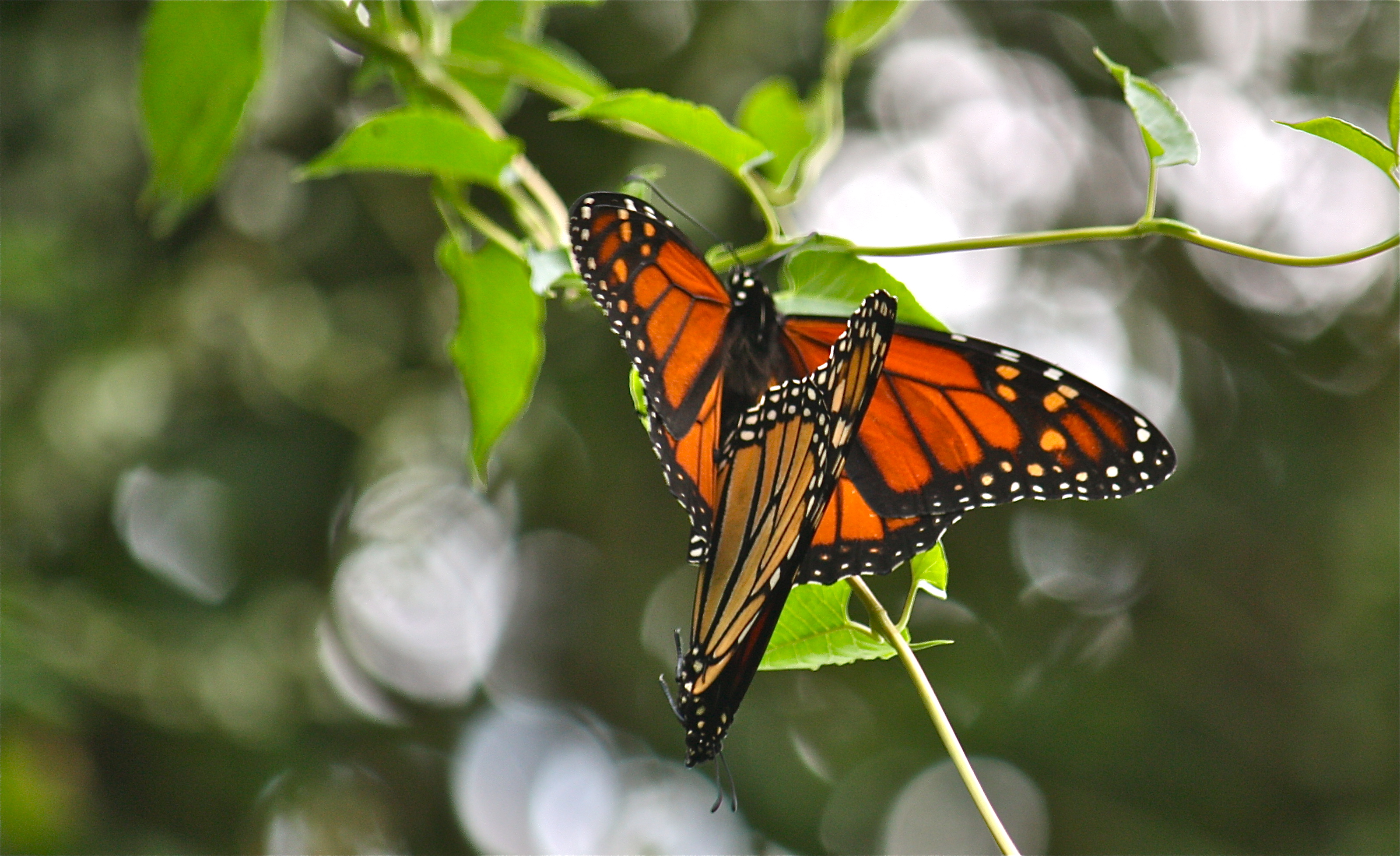
 A Pair of Monarchs Mating in Our Pear Trees
Excerpt from Part One: Creating the Framework, Chapter One
He who plants pears, Plants for heirs
Pyrus communis, or common European pear, is not seen growing in the wild. The cultivated pears as we know them today are thought to be derived from Pyrus nivalis and P. caucasia. Few pears ripen well on the tree and that may be one reason they have not been grown as extensively in America as apples and peaches, although apple and peach trees are not as long lived as pear trees. A healthy pear tree can live and bear fruit for several centuries.
The trick to harvesting pears is to pick them as they are ripening, while they are still quite firm. If you wait until the flesh yields with pressure on the outside, the fruit will be rotted inside. Each individual variety of pears has an estimated ripening date from when the tree blooms. Note the date when the tree begins to flower and count the days forward to the approximate ripening time. The quality of the soil, where the tree is sited, as well as changes in the weather from year to year will influence the number of days until the pears are ready to be harvested. Bearing in mind that this is only an approximation, begin monitoring the fruit closely as the day approaches. Nearing the correct time of harvest, the color of the fruit will begin to change. For example, the ‘Beurre Bosc’ begins to turn a light golden yellow beneath its russet skin. Carefully hold the stem of the pear in one hand and the fruit-bearing spur in the other hand. Gently twist with an upward turn. Remove the pear and stem, not the bumpy, fruit-bearing spur. It takes several years for a spur to develop, and if damaged or accidentally harvested with the pear, the crop will be significantly decreased the following year.
Stack the fruit in the coldest section of a refrigerator and store for several weeks. After two to three weeks, remove a pear or two and let it ripen at room temperature for several days. At this point the pear will ideally be fully ripe and ready to eat. Depending on the cultivar, pears will keep for weeks to several months when kept well chilled.
Like this:
Like Loading...

 The illustration above is of a male and female Monarch mating. The Monarchs fly up into a tree and stay joined together, abdomen to abdomen, for about four hours. The blue butterflies are a cousin of the Monarchs, the Blue Tiger of India (Tirumala limniace), but you can color your butterflies anyway you see fit–I’d love to see a pair of rainbow Monarchs 🙂