Category Archives: The Fragrant Garden

Moon Vine

It was my joy to give the lecture, held at the Wenham Museum’s North Shore Design Show, on gardening for fragrance. Thank you to Lindsay, Yvonne, Leon, Pauline, Elizabeth, Julie, Lisa, Sandra, Polly, Eliza, and everyone else whose name I did not get, for your interest and great questions.

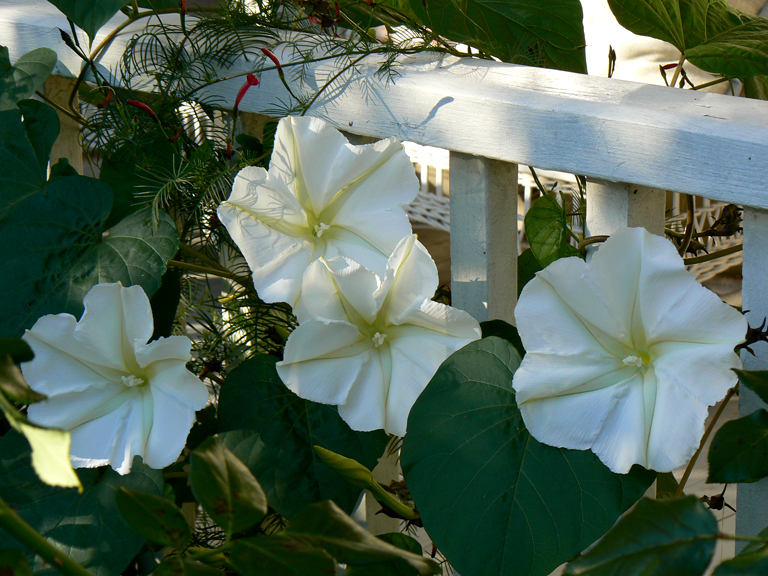
No garden planted for fragrance would be complete without growing moon vine. Plant moonflowers and cypress vines in late May and early June for September blossoms. Moon vine will give you dreamily-scented late summer nights and cardinal climber will provide nectar for southward migrating Ruby-throated hummingbirds

Moon Vine, Moonflowers (Ipomoea alba)Our moon vine-embowered porch in September

“You can tell in the afternoon which buds will open that night. In the South, where I used to live, it was the custom to keep an eye on the moon vine, and when sixty or so buds showed they would open that night, to ask people over to watch them. Unfortunately, people in the country talk so much that I cannot recall seeing the buds open very often. They tremble and vibrate when they open. Usually someonewould say “the flowers are out,” and everyone would run over to admire them, then back to jabbering.

Equally festive is the night-blooming cereus. In our neighborhood there lived an old cereus in a tub. It was ninety-seven years old, the last time I saw it, and produced 120 flowers open at once. When it bloomed (and you can tell by afternoon which buds will open) its proud owner would phone round the neighbors and there would be punch or champagne (rather dangerous in hot weather) and cucumber sandwiches for refined persons, and ham and potato salad for mere mortals. These parties, once such a feature of the American summer, were always spontaneous, since you only had a few hours to plan them and invite people. It was always astonishing to see how many people could come at the last minute.”

— Henry Mitchell ~ The Essential Earthman


Ruby-throated Hummingbird and Cardinal Climber, Cypress Vine Ipomoea x multifida

Perhaps this is the summer we will have our first moon vine party–and I will provide tea sandwiches for my refined friends and ham and potato salad for we mere mortals. What fun to imagine. Grow cardinal climber and moon vine together for a delightful combination of delicately toothed  and bold heart-shaped leaves–day flowering red trumpets for the hummingbirds and night blooming sweetly scented blossoms for you.

*Logees Greenhouse carries night-blooming cereus (Epiphyllum oxypetalum).


Lily of-the-valley

Lily of-the-valley Convallaria majalis

Lily of-the-valley

No flower amid the garden fairer grows

Than the sweet lily of the lowly vale,

The queen of flowers.  — John Keats (1795-1821)

With its incomparable perfume and snow-white flowers issuing forth in the bright hopeful season of spring, the lily of-the-valley has long been associated in literature with sweetness and the return of happiness.

The lily of-the-valley, known also as May lily and May bells, is native to northern Europe, the Allegheny Mountains of North America, and the British Isles. Between a pair of unfurling new-green leaves emerges a diminutive arching scape, covered in dangling pure white chubby bells. Their fabulous fragrance floats freely throughout the garden, unusual for a plant that grows close to the ground.

Beloved wherever it is grown, for its ineffable scent and sweet flowers, the lily of-the-valley is used extensively for perfumes, soaps, and toilet water, nowhere more so than in Europe. The French translation is muguet des bois (of the wood), the German trans-lation is mit Maiglockchen, the Italian al mughetto, the Spanish say lirio del valle, the Finnish translation is lehmakielo, and the Swedish say liljekonvalj.

Convallaria majalis is the native species of northern Europe. The name Convallaria is from two Latin words meaning “with” and “valley,” having reference to its habit of growing on mountain slopes. C. majuscula is the species indigenous to North America. Convallaria majuscula is found growing in remote woodland locations, along the mountainsides and ridges of Virginia, West Virginia, and south to Georgia. C. majuscula is nearly identical to C. majalis, with slightly smaller though equally fragrant flowers.

Lily of-the-valley is a vigorous perennial ground cover with a rhizomatic root structure that grows and spreads quickly. Thriving in nearly every light condition save full sun, lily of-the-valley never disappoints. Light, fertile, and preferably damp soil is the preferred growing medium of C. majalis. Provided with an annual mulch of compost or decaying leaves, lily of-the-valley multiplies rapidly. With its cold hardiness, ability to spread readily, and pervasively fragrant blossoms it is incomparable as a ground cover. The one drawback of lily of-the-valley is that, come late August, the foliage browns and becomes tattered. Grow with late season blooming perennials and bulbs, Japanese anemones and peacock orchids, for example, to draw your eye up and away from the messy foliage.

Set the pips, or bulblets, three inches deep and about four inches apart in a well-prepared bed. Water during dry periods and fertilize with fish fertilizer throughout the first season after planting to encourage strong root development. After it has become well established, the plant is easily propagated. A freshly dug clump, as a whole unit, can either be transferred and replanted in a newly dug and well-prepared location, or the bulblets can be carefully divided and spread more judiciously, allowing for a small section of roots for each one or two pips. Plunge a serrated-edge knife deeply into the ground. Cut out a plug six to eight inches in diameter. Refill the hole created by digging the clump with compost. Lily of-the-valley will soon recover and fill out the spot. Early spring and mid-fall are the best times of year to divide C. majalis, although they are not that fussy. If the plant has to be divided in the summer, water regularly to prevent the new division from drying out while becoming established in its new home. With regular thinning and transplanting, one’s extra efforts will be rewarded with an ever-increasing treasure of scented flowers and sea of green groundcover, with many gifts to pass along to friends.

Not to be forgotten is the noteworthy Convallaria majalis var. rosea. Characteristic in form to the white lily of-the-vale, rosea has delicate, pendulous bells washed in shades of rosy pink. We have found it to be somewhat less hardy than Convallaria majalis.

A cautionary note is in order regarding Convallaria. All parts of the plant are highly poisonous. In old herbal guides, lily of-the-valley was recommended as a heart stimulant, and was used medicinally in ways similar to digitalis. The eyecatching, plump vermilion berries may be dangerously attractive to young children and can cause paralysis and severe respiratory disorders if ingested.

Lily of-the-valley Convallaria majalis

What a find this weekend!–a sweet handblown bud vase, perfect for lily of-the-valley, found amongst a tumble of dusty old perfume bottles at an antique shop in Essex. So dear –the fragrance of lily of-the valley brings delicious childhood memories of picking handfuls with my Mom at my grandmother’s garden. Happy Mother’s Day Mom!

The Fragrant Garden

Dear Gardening Friends,

I hope you can participate in my upcoming gardening lectures and classes. My spring schedule is posted on the Events page.

Life is full—our daughter Olivia is graduating from Boston University next weekend, our son is working hard in school and at the job he so loves, and Tom and I both have as much work and projects as we can possibly manage—no small feat in this economy. And we have a new puppy–a tulip eating puppy! More about Miss Rosie Money Penny will be posted.

The foillowing is an excerpt from the chapter on gardening for fragrance from my book Oh Garden of Fresh Possibilities!, to coincide with the lecture I will be presenting at the North Shore Design Show “Favorite Spaces” exhibit, at 11:00 am on Saturday morning, May 22 at the Wenham Museum. For more information about the North Shore Design Show and to see their full calendar of events, follow this link: 2010 Spring Benefit.

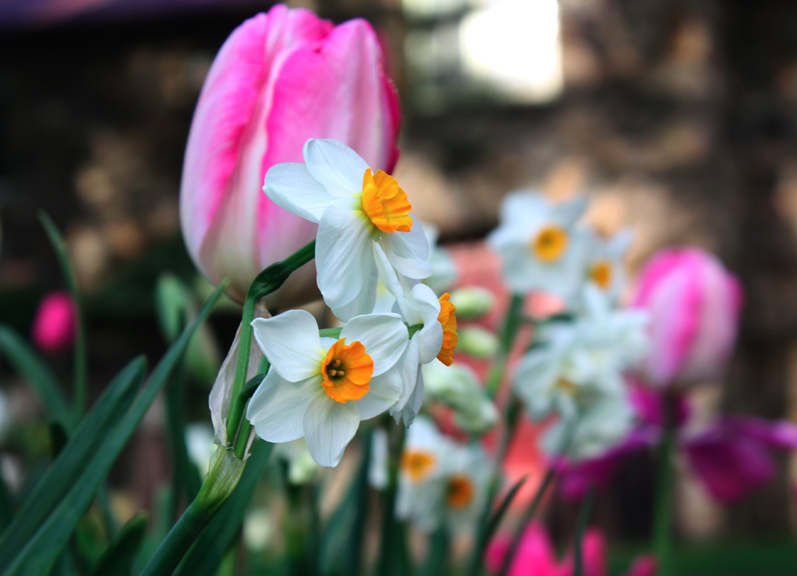
‘Geranium’ narcissus

A note about ‘Geranium’: Sweetly scented, ‘Geranium’ narcissus reliably returns year after year. For a list of fabulously fragrant jonquils and narcissus see pages 178-179 in Oh Garden of Fresh Possibilities!

The Fragrant Garden

Part One

A garden, a small garden especially, is made more intimate when planted with an abundance of fragrant blooms and foliage. The air impregnated with the scents of flowers and foliage imbues a memorable atmosphere in the garden, playing the subtle, and sometimes not so subtle, role of strengthening the ambiance we wish to create. Fragrance, elusive, emotionally colored, and so entirely related to experience, welcomes us as we walk through the pathways of our garden.

The idea of creating a fragrant garden is deeply rooted in ancient history. One of the earliest aromatic gardens was the Hanging Gardens of Babylon, built in the 6th century b.c. by King Nebuchadnezzar for his wife Amytes, daughter of the King of the Medes. The Greeks described these resplendent gardens, supported by stone columns with irrigated terraces. The most potently fragrant plants were grown here, and the terraces, which bloomed with lilies and roses, were favored by Queen Amytes for her walks.

The countries of the Middle East abound with an array of scented trees and plants. From historical records dating back to 2500 b.c. we know that the enclosed courtyards of the Persian palaces were planted with jasmine, fruit trees (especially oranges), hyacinth, myrtle, and jonquils. But above all other flowering plants, the rose was held in the highest esteem. The Damask rose grew in nearly every garden in Syria. The country takes its name from the word Suri (a delicate rose), hence Suristan (the land of roses).

From tomb paintings and bas-reliefs we learn of gardens and the use of plants in ancient Egypt. The verdant, fertile flood plain created by the annual rise and fall of the Nile, coupled with the Egyptians’ skill in engineering and irrigation, allowed a wealth of indigenous and imported fruiting trees, vines, and flora to grow in abundance. One of the earliest botanic collections was that of plants and seeds brought back from Syria in approximately 1450 b.c. The images of the plants were carved on the walls of the temple of Thothmes II in Karnak. The Egyptian Papyrus Ebers (written about 1552 b.c.) describes scented plants and remedies and their methods of use. The gardens, enclosed by mud walls, were planted with aromatics and medicinal herbs. Some of the plants described include frankincense, myrrh, saffron crocus, Madonna lily (Lilium candidum), cinnamon, and orchards of pomegranates. The Egyptians were among the earliest peoples to show an appreciation for perfume. Incense and perfume were used extensively for religious and funeral rites. Fragrant oils were used to massage their bodies and concoctions of scented herbs were taken to sweeten the breath. Priests performed the daily ritual of burning fragrant woods as offerings to the gods. The wood was burnt on alters in the temples. The word “perfume,” from the Latin per, “through,” and fumun “smoke,” shows that the origin of the word lay in the burning of incense, both to ‘offer up’ the gratitude of the people to the gods for favors received, and to ask for their blessings in time of trouble. The Egyptians believed their prayers would reach the gods more quickly when wafted by the blue smoke that slowly ascended to heaven.

The Egyptians’ reverence for nature is noteworthy in their use of floral motifs in decorative ornamentation. The lotus and papyrus were by far the most prevalent, together with the daisy, palm, convolvulus, and grape vine. The ‘Blue Lotus of the Nile’ (Nymphaea stellata coerulea), a member of the water lily family, is the lotus flower depicted in ancient Egyptian decorative ornamentation. The fragrance emanating from the lotus creates an intoxicating atmosphere; they have a scent similar to hyacinths. The flowers are star-shaped and sky-blue with brilliant golden centers and stand several inches above the water. The lotus had an inexhaustible symbolism in ancient Egypt, Daoism, Buddhism, and Hinduism alike.

The lotus is significant as it was the symbol of Upper Egypt. When used in ornamentation with the papyrus it symbolized the union of Upper and Lower Egypt, whose symbol was the papyrus. A well-known example of this is the soaring twin pillars that tower over the ruins at Karnak. One capital is decorated with the lotus and the other with papyrus.

The ‘Blue Lotus of the Nile’ had a deeper religious significance. Because the lotus blooms each day, withdraws under the water at sunset, and reemerges the following morning, it was closely linked to the daily rhythm of the rising and setting of the sun and thus to the story of the sun god, creation, and rebirth. The blue petals represented the sky and the golden center the emerging sun. The lotus motif was used to decorate pottery, jewelry, clothing, and appears extensively in the decoration of the capitals of pillars and columns. A wide variety of designs using the lotus flower were employed, in repeating border patterns and in alternating patterns with lotus buds or bunches of grapes. The buds fit harmoniously into the curves between the flowers. During the reign of Akhenaten (New Kingdom, 18th Dynasty) the lotus designs become less stylized and more freely expressed.

When thinking about the history of garden design in the context of our own gardens, we are free to determine our own personal preferences while drawing inspiration from what has come before. By following one’s intuitive powers and adhering to nature’s contours specific to an existing site, the inherent beauty of the garden can be realized. In describing our fragrant path, rather than draw for you a picture of what to grow precisely, as each individual garden setting is unique, the following are suggestions of plants for a well-orchestrated sequence of fragrant flowering plants. The underlying framework would ideally be composed of as many fragrant flowering and fruiting trees and shrubs as are reasonable, including an abundance of aromatic and healthful herbs. And the garden overflowing with scented blossoms provides you with armfuls of flowers to cut and bring indoors to scent the rooms of your home.

Part Two will be posted next week.


Tulipomania at Willowdale!

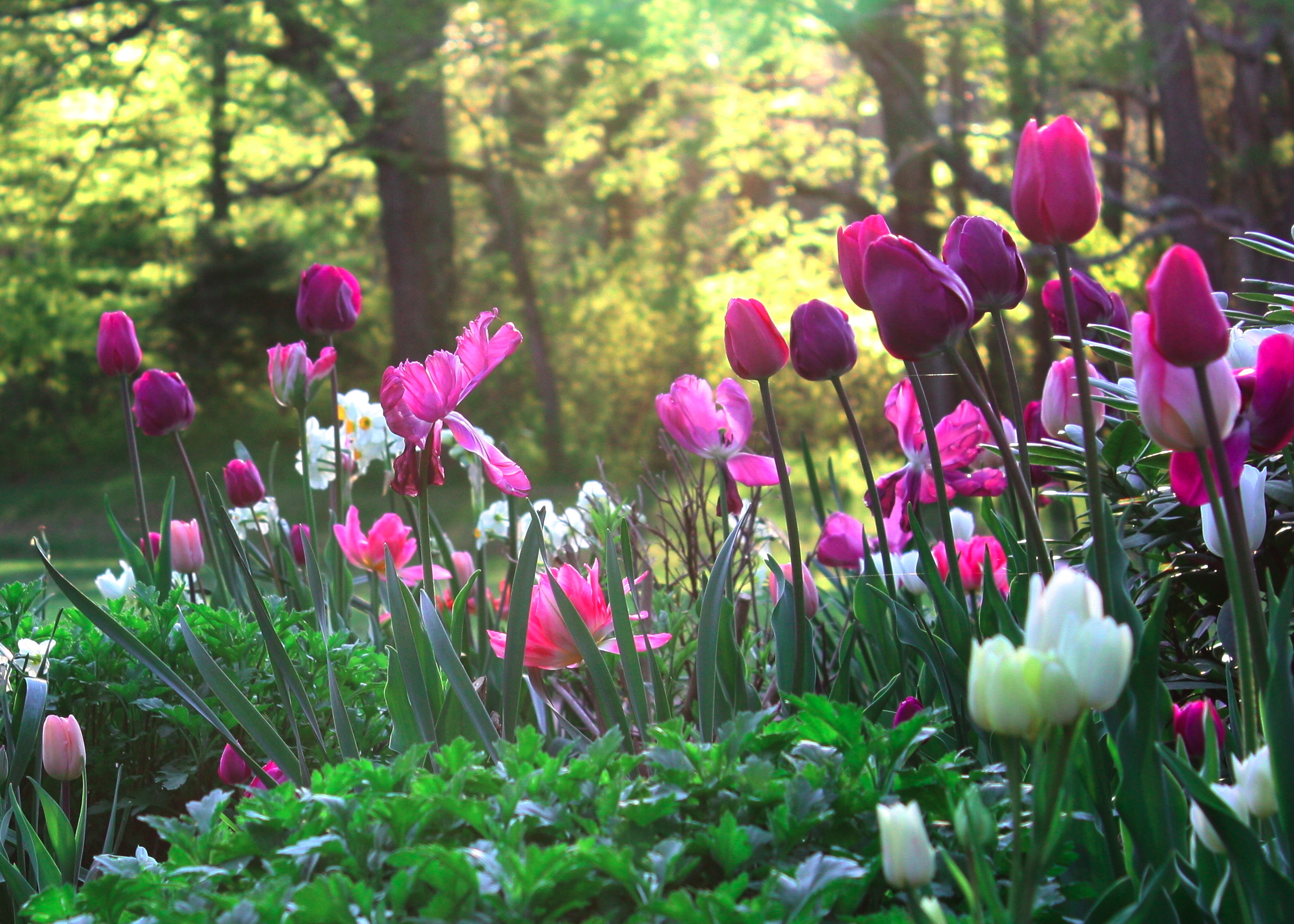
Tulips Blooming at Willowdale Estate Topsfield Massachusetts

The bridal season has begun and the grounds are topfull of tulips and sweetly scented jonquils. While photographing with eyes and nose at flower height, I am intoxicated by the the heady perfume emanating from the narcissus and the splendorous hues and broken patterns of the shimmering satin tulip petals–and dreaming about making cocktail dresses in every colorway! Lenna (from Willowdale) and I are creating a book of garden photographs for the brides, and because all the flowers and butterflies are so gorgeous, it is a challenge to decide what photos to include. Dan Pritchard, who works for my publisher, David Godine, suggested that I post  regular updates on what is currently in bloom at Wdale and I think it is a great idea. The following are a few potential candidate photographs to add to the spring section of our photo book.

Tulips Blooming at Willowdale Estate Topsfield Massachusetts

Tulips and Narcissus Blooming at Willowdale Estate Topsfield Massachusetts

The new pergola designed by Gerald Fandetti, Architect

Pergola designed by Gerald Fandetti, Architect

Native dogwood (Cornus florida) with tulips

Native dogwood (Cornus florida)

Wisteria Arbor in the Butterfly Courtyard

Wisteria Arbor in the Butterfly Courtyard at Willowdale Estate, Topsfield

Viridiflora Tulip ‘Greenland’


Three Bees

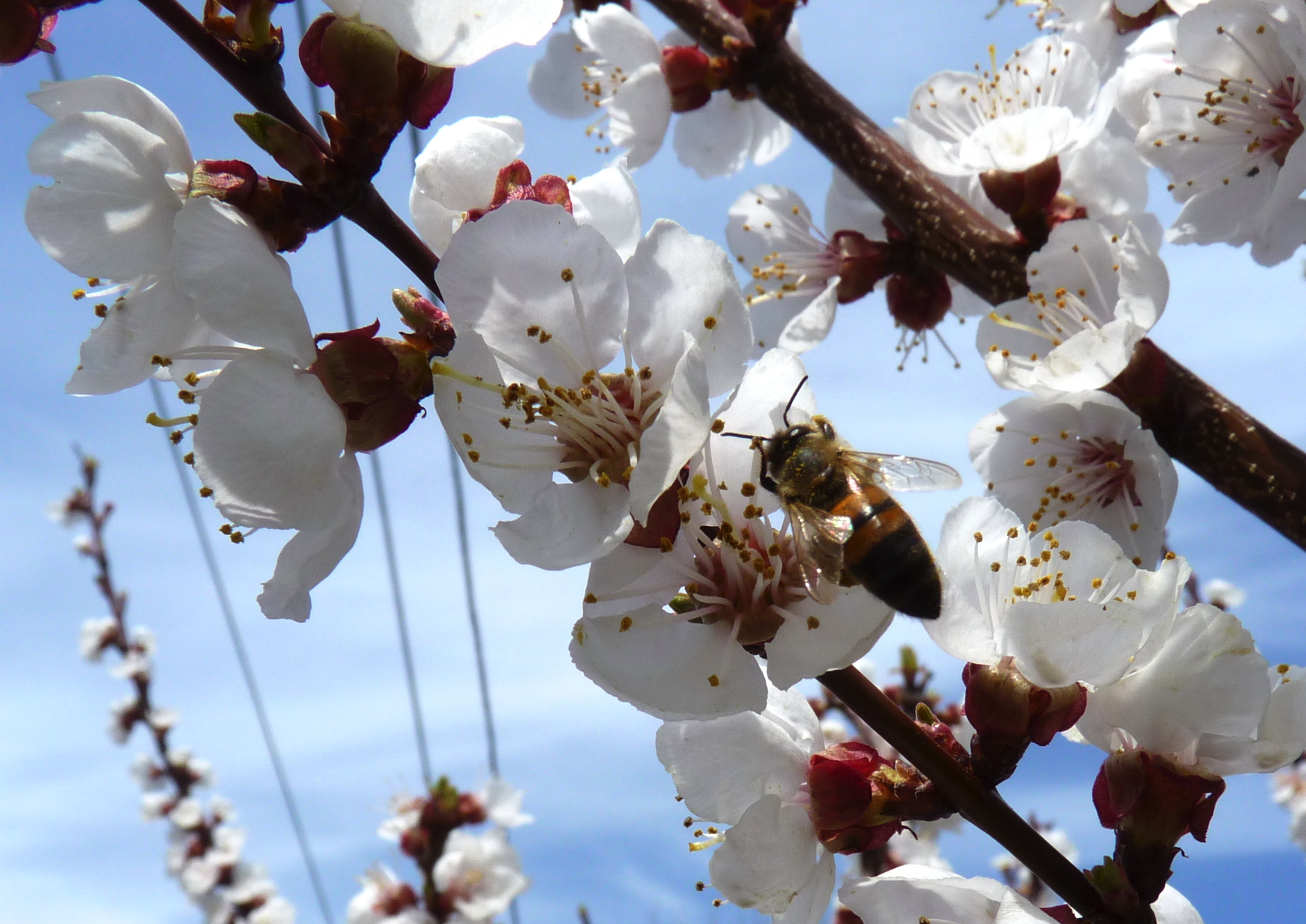
With family visiting for the past week, in honor of our darling daughter’s senior recital, I have been up to my elbows in cooking. I did manage to run out into the garden to photograph our apricot tree in full glory. Apricot trees provide a fantastic source of nectar for native bees in early spring. The blossoming time of apricots is fleeting and, as the petals were drifitng like snowflakes all around me, the pollinators were working furiously. I counted at least seven different species of bees, some so tiny they did not photograph at all well. The first photo is of a carpenter bee and the other two have yet to be identified.

Apricot Blossom with Carpenter Bee

Apricot blossom native bee

Apricot tree Native bee